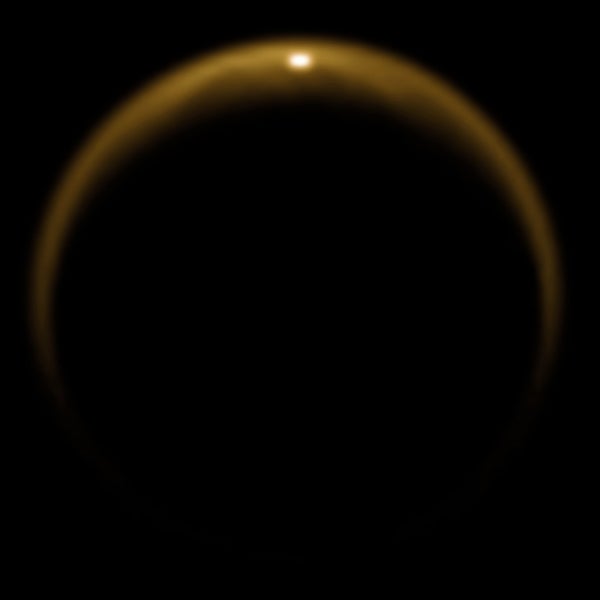
Titan lake shines in sunlight

SAN FRANCISCO—NASA’s Cassini probe has snapped the first images of sunlight reflected off one of the hydrocarbon lakes at Saturn's moon Titan.

NASA

Join Our Community of Science Lovers!


On supporting science journalism

If you're enjoying this article, consider supporting our award-winning journalism by subscribing. By purchasing a subscription you are helping to ensure the future of impactful stories about the discoveries and ideas shaping our world today.


SAN FRANCISCO—NASA’s Cassini probe has snapped the first images of sunlight reflected off one of the hydrocarbon lakes at Saturn's moon Titan. Although the existence of liquid lakes there had already been confirmed by other means, this was a long-sought direct visual confirmation. Cassini scientists presented the images here Friday at a meeting of the American Geophysical Union.


"It was a little bit of luck," says Katrin Stephan of the German Aerospace Center in Berlin, who was the first person to spot the glint while browsing newly arrived infrared images. (Titan's atmosphere is too hazy for the lakes to be seen in the visible-light spectrum.) Cassini took the shots on July 8 from a distance of 200,000 kilometers, as it hurtled toward Titan for a flyby. Three out of four exposures taken within a three-hour period showed a beam of light on the edge of the moon. To rule out other potential phenomena, such as lightning or perhaps a volcanic eruption, Stephan and her collaborator checked that the alignment of the sun, Titan and the probe was just right for light to bounce off a lake. "It fit perfectly together," she says.

It’s Time to Stand Up for Science

If you enjoyed this article, I’d like to ask for your support. Scientific American has served as an advocate for science and industry for 180 years, and right now may be the most critical moment in that two-century history.

I’ve been a Scientific American subscriber since I was 12 years old, and it helped shape the way I look at the world. SciAm always educates and delights me, and inspires a sense of awe for our vast, beautiful universe. I hope it does that for you, too.

If you subscribe to Scientific American, you help ensure that our coverage is centered on meaningful research and discovery; that we have the resources to report on the decisions that threaten labs across the U.S.; and that we support both budding and working scientists at a time when the value of science itself too often goes unrecognized.

In return, you get essential news, captivating podcasts, brilliant infographics, can't-miss newsletters, must-watch videos, challenging games, and the science world's best writing and reporting. You can even gift someone a subscription.

There has never been a more important time for us to stand up and show why science matters. I hope you’ll support us in that mission.

Thank you,

David M. Ewalt, Editor in Chief, Scientific American

Subscribe