
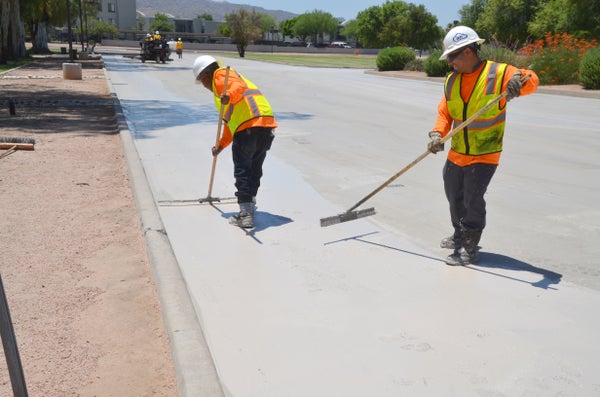
Researchers in Arizona have found that urban heat islands made worse by sun-baked asphalt roads can be mitigated by a relatively simple measure.
Paint the streets gray.
A study by Arizona State University and the city of Phoenix found that applying a reflective, gray-colored emulsion material to black asphalt resulted in a 10.5- to 12-degree-Fahrenheit drop in average road surface temperatures, while sunrise temperatures saw an average 2.4-degree drop.
On supporting science journalism
If you're enjoying this article, consider supporting our award-winning journalism by subscribing. By purchasing a subscription you are helping to ensure the future of impactful stories about the discoveries and ideas shaping our world today.
“This is exactly what we were hoping for,” Phoenix Mayor Kate Gallego said in a statement. “While there’s work to be done, it’s exciting to see a technology that has the potential to meet the demands of a growing desert city in a world where temperatures are constantly rising.”
Experts say road temperatures in the Phoenix area can rise to 180 degrees on a hot day. That absorbed energy remains in paved surfaces for hours, radiating heat back into nighttime air. Higher overnight temperatures result in warmer mornings, creating a cycle of urban heat island effect.
Researchers found that the greatest temperature differential was near the road surface, with less dramatic results 6 feet above the ground. Even so, the neighborhoods with reflective streets experienced air temperatures 0.3 degree cooler during the day and 0.5 degree cooler overnight compared with neighborhoods with black-topped roads.
But reflective pavements don’t affect all surfaces the same way. Ariane Middel, an urban climatologist and assistant professor at Arizona State, said in a release that “the most meaningful measurement” was of radiant temperatures, a measure of how the body experiences heat.
Those measurements—taken by researchers walking treated streets pulling a small cart equipped with meteorological sensors—showed that the “human experience of heat exposure at noon and the afternoon hours was higher due to surface reflectivity, but similar to walking on a typical concrete sidewalk.”
Researchers said the increase in felt temperatures “may be a necessary trade-off to reduce surface temperatures using a reflective surface.”
Heather Murphy, a spokesperson for the Phoenix Street Transportation Department, said the response has been mixed from drivers and residents in neighborhoods where the material is applied. “We have had some people who don’t like the aesthetics of it, but generally the response has been very positive,” she said.
She said the department fielded questions early on about glare and visibility, but when dry, the coating has no effect on driver visibility: “It looks just like the road surface you see on an interstate highway.”
The coating, called CoolSeal, is a water-based asphalt emulsion made by California-based GuardTop, but it is not available for purchase by individuals or homeowners, Murphy said. The company’s website said it completed a product demonstration last December for the city of Los Angeles’ Bureau of Street Services.
Still, officials cautioned that reflective pavement is not a panacea for the urban heat island effect.
“If you’re standing over one of these surfaces on a hot day, you’re still going to be hot if you’re not in the shade,” said Jennifer Vanos, an assistant professor at Arizona State’s School of Sustainability who worked on the study. “So if we really want to be pushing towards true solutions to the heat problems, it’s not going to be just paint all the streets white.”
A second phase of the study is forthcoming and will examine questions about how the material performs under varying conditions, including changes in reflectivity, traction/skid, degradation and subsurface temperature over longer periods.
Reprinted from E&E News with permission from POLITICO, LLC. Copyright 2021. E&E News provides essential news for energy and environment professionals.