
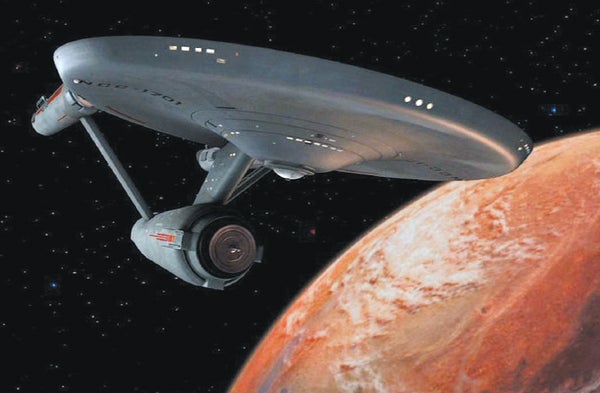
Before kindergarten, I was already dreaming about the wonders of interstellar space travel. I saw the Apollo astronauts walk on the moon and enjoyed the weekly exploits of the crew of the Enterprise on the original Star Trek TV episodes. It seemed we'd soon be leaping into that “final frontier.” But the adult me now knows a lot more about how hard it is to explore the cold vastness of space—even if we're doing so with machines instead of us fragile humans. Robot missions to next-door neighbor Mars a mere 225 million kilometers away on average have failed with unpleasant frequency. It's almost as if the universe seems to dare us to go big or stay home.
Our cover story, then, brings you the tale of just such a big idea, which aims to reach a nearby star using something very small. A lot of millimeter-size things, actually. In “Near-Light-Speed Mission to Alpha Centauri,” journalist Ann Finkbeiner relates how the Breakthrough Starshot mission plans to journey to Alpha Centauri, about four light-years away. It would use “StarChips” on light sails propelled by laser light. Based on chips similar to those in smartphones, they would take pictures and make other readings during a brief flyby. The plan is risky, expensive—and it may not work. But it's an exciting idea to tackle the hard problem, and I hope you enjoy learning about it as much as I did.
Another place that's hard to reach is the distant past. That doesn't stop us from looking for clues about it in the present—and sometimes finding them. What color were the dinosaurs, for instance? But one day biologist Jakob Vinther spied the fossilized ink of a 200-million-year-old squid relative, perfectly preserved. It looked like granules of melanin pigment. He began to wonder if melanin might survive in fossils. Voilà—an intriguing pathway to what things were like in another place and time. In “The True Colors of Dinosaurs,” you will learn the surprising insights scientists are gaining from this new look at old creatures.
On supporting science journalism
If you're enjoying this article, consider supporting our award-winning journalism by subscribing. By purchasing a subscription you are helping to ensure the future of impactful stories about the discoveries and ideas shaping our world today.
As ever, Scientific American is also fully engaged with how science might solve some of humanity's greatest challenges. “Brain Trust,” by neuroscientist Kimberly G. Noble, examines how growing up in poverty affects a child's cognition and brain development. Could a simple remedy—a cash stipend for families to ease financial straits—help children to reach their potential? The process of science will lead us to find out.