
Movies like Jaws portray sharks as the stuff of nightmares. In reality, the animals have more to fear from people than we do from them. An estimated three sharks die every second worldwide because of overfishing, getting caught in massive fishing operations, having their fins cut off or deterioration of their habitats.
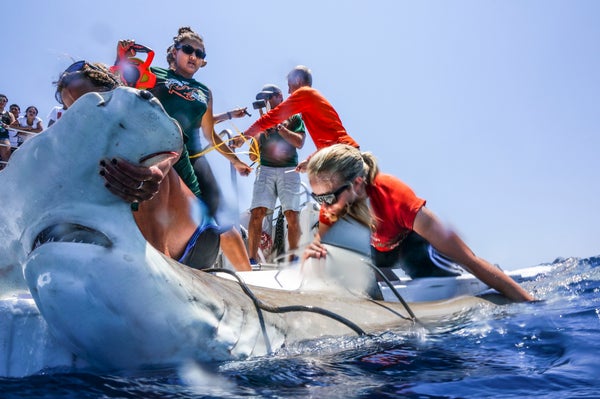
A team of shark wranglers in the University of Miami’s R. J. Dunlap Marine Conservation Program (RJD) is trying to help sharks in the subtropical Atlantic by fitting them with customized tracking tags. RJD photographer Catherine Schulz snapped this photo of a great hammerhead shark that was caught, labeled and released back into the ocean in good condition. The two women handling the shark are using their hands and a thick wire to stabilize it against the boat. The woman on the left holds the shark’s head while the other stabilizes its fins and body. The woman standing in the middle is about to measure the body and fins with a measuring tape. The man holding the mallet behind the woman will hammer a number tag into the shark’s fin for easy identification.
The satellite tags, which are equipped with GPS antennas, allow the team to keep tabs on the shark’s temperature, depth and movement through the water. They can scrutinize groups of sharks’ migration patterns or study how the creatures interact with different protected or heavily fished regions of the ocean. They can even tell scientists where the sharks like to graze, mate and give birth.
On supporting science journalism
If you're enjoying this article, consider supporting our award-winning journalism by subscribing. By purchasing a subscription you are helping to ensure the future of impactful stories about the discoveries and ideas shaping our world today.
The tags, which can be permanently attached or set to be released and retrieved by scientists later, transmit data in real time or store information on a memory card. Once researchers identify areas where sharks tend to go, they can pass this information along to policy makers, so that they can deploy resources aimed at protecting the sharks more effectively.
—Julia Calderone