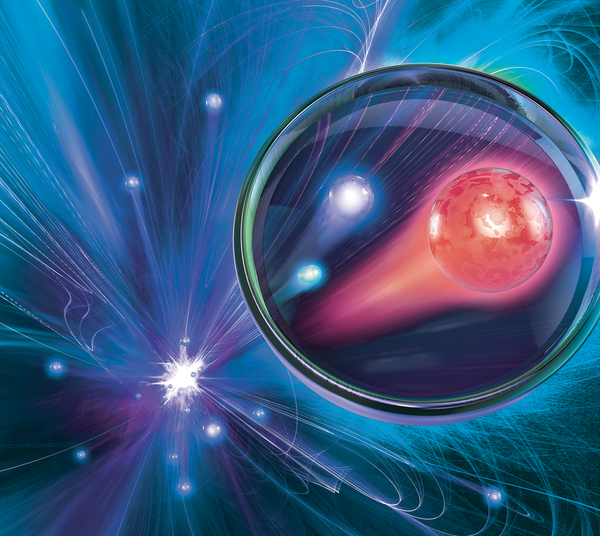
To See or Not to See

Researchers are one step closer to determining how heavy the universe’s lightest matter particle might be

Mark Ross Studio

Join Our Community of Science Lovers!


On supporting science journalism

If you're enjoying this article, consider supporting our award-winning journalism by subscribing. By purchasing a subscription you are helping to ensure the future of impactful stories about the discoveries and ideas shaping our world today.


As you read this word, and now this one, some billions of subatomic particles called neutrinos are whizzing through your body. The most mind-boggling aspects in physics are often the invisible ones, as well as where the biggest research booty lies. Discovering the nature of that we can’t see in the universe promises to answer the most enticing cosmic questions: What spurred the formation of the universe, and what propels it ever outward? So while they can’t see neutrinos, physicists still want to learn all they can about them. As Clara Moskowitz reports in “Mysterious Neutrinos Get New Mass Estimate,” the mass of neutrinos—yes, they have some—has upper limits. Further, the more we learn about this mysterious particle, the more we question the Standard Model of particle physics.

Back in the visible realm, Shannon Hall describes the renewed push to explore the planets Neptune and Uranus, which have been on the back burner for decades (see “The Solar System’s Loneliest Planets, Revisited”). And if it seems like discoveries in physics and astronomy are constantly ramping up, think of the torrents of data rolling in from the telescopes and detectors on Earth. As Anil Ananthaswamy reports, multimessenger astronomers are turning to machine learning to help them process the influx of measurements pouring in from exploding stars, galactic nuclei and colliding neutron stars, to name a few (see “Faced with a Deluge, Astronomers Turn to Automation”). Visible or not, we’re diving in.

Andrea Gawrylewski is chief newsletter editor at Scientific American. She writes the daily Today in Science newsletter and oversees all other newsletters at the magazine. In addition, she manages all special editions and in the past was the editor for Scientific American Mind, Scientific American Space & Physics and Scientific American Health & Medicine. Gawrylewski got her start in journalism at the Scientist magazine, where she was a features writer and editor for "hot" research papers in the life sciences. She spent more than six years in educational publishing, editing books for higher education in biology, environmental science and nutrition. She holds a master's degree in earth science and a master's degree in journalism, both from Columbia University, home of the Pulitzer Prize.

More by Andrea Gawrylewski
SA Space & Physics Vol 2 Issue 5This article was published with the title “To See or Not to See” in SA Space & Physics Vol. 2 No. 5 (), p. 2
doi:10.1038/scientificamericanspace1019-2

It’s Time to Stand Up for Science

If you enjoyed this article, I’d like to ask for your support. Scientific American has served as an advocate for science and industry for 180 years, and right now may be the most critical moment in that two-century history.

I’ve been a Scientific American subscriber since I was 12 years old, and it helped shape the way I look at the world. SciAm always educates and delights me, and inspires a sense of awe for our vast, beautiful universe. I hope it does that for you, too.

If you subscribe to Scientific American, you help ensure that our coverage is centered on meaningful research and discovery; that we have the resources to report on the decisions that threaten labs across the U.S.; and that we support both budding and working scientists at a time when the value of science itself too often goes unrecognized.

In return, you get essential news, captivating podcasts, brilliant infographics, can't-miss newsletters, must-watch videos, challenging games, and the science world's best writing and reporting. You can even gift someone a subscription.

There has never been a more important time for us to stand up and show why science matters. I hope you’ll support us in that mission.

Thank you,

David M. Ewalt, Editor in Chief, Scientific American

Subscribe