
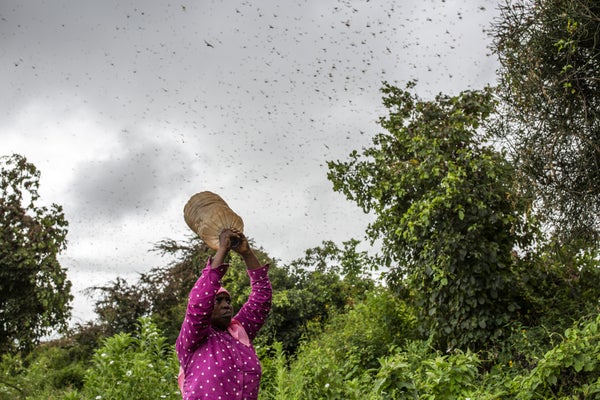
NOAA is lending technical support to the United Nations in its battle against a massive locust infestation that’s spread from Africa into the Middle East and Asia.
NOAA’s assistance is helping officials control the spread of the pests, but the U.N. says new desert locust swarms are advancing into India, threatening food supplies there.
Meanwhile, heavy rainfall and devastating flash flooding are hampering efforts to knock out the infestation for good.
On supporting science journalism
If you're enjoying this article, consider supporting our award-winning journalism by subscribing. By purchasing a subscription you are helping to ensure the future of impactful stories about the discoveries and ideas shaping our world today.
Wild weather, including severe droughts interrupted by torrential rains, has produced ideal breeding conditions for the desert locust, a pest that has threatened crops since biblical times. The extreme weather patterns have been linked to rising average global temperatures caused by the accumulation of greenhouse gases in the atmosphere.
The U.N. Food and Agriculture Organization and World Food Programme warn that the risk of famine in the region is rising quickly. The locust infestation, combined with the coronavirus pandemic, is threatening food security for hundreds of millions of people.
FAO says the desert locust is “the most destructive migratory pest in the world,” capable of wiping out crops and pasturelands. U.N. agencies have asked for $150 million in government assistance to combat the locust swarms and so far have received about $130 million, according to a recent progress report.
New technology developed at NOAA is helping FAO track the locust swarms and plan control efforts such as insecticide spraying. NOAA says it has repurposed technology that’s used to track plumes from volcanoes and wildfires into a web application that FAO can use to anticipate the migratory paths of billions of locusts.
The application works by tracking and forecasting wind patterns. The desert locust is a passive flying species that typically follows the wind. Knowing wind patterns can help U.N. authorities pre-position material and personnel in an effort to prevent croplands from being destroyed.
NOAA lead scientist Mark Cohen acknowledged that the technology, based on NOAA’s HYSPLIT dispersion model, is still limited but that upgrades could be added.
“Right now, it mainly works by tracking wind patterns,” Cohen explained. “At present, there is no functionality to attempt to incorporate locust breeding patterns. Additional features could potentially be added to the system if the relevant scientific information about locust behavior can be identified and if resources were available for this type of extension.”
Cohen said the technology may eventually be made available to more users, “but this will require additional software engineering, more computational resources, user’s guides, dedicated user support resources and other items.”
For now the application is reserved for official use at FAO, he said.
Before NOAA’s assistance, FAO mainly tracked the expansion of the swarms by on-the-ground reports or satellite monitoring while using weather forecasts to guess where the locusts may spread to next.
“Our initial goal is to respond to an urgent request for help from FAO to make their HYSPLIT-based locust forecasting more accurate and efficient,” Cohen said.
Some 365,000 hectares of land has been treated across a wide swath of eastern Africa and Yemen, with efforts focused on 10 highly impacted countries.
Despite the progress, FAO announced this week that new swarms have found their way to India. The agency also warned that the locust plague could advance west to the African Sahel region this summer should control efforts falter.
Officials are also worried about heavy rains and flooding in recent days in countries where control efforts are underway.
The World Meteorological Organization says higher-than-average Indian Ocean temperatures are producing devastating flash floods in Kenya, Rwanda, South Sudan and Uganda. WMO worries the conditions will make it easier for the locusts to breed in greater numbers.
“The current situation and forecast are alarming as locust infestations are expected to extend to other areas in the Horn of Africa and southwest Asia,” WMO said in a release. “Although control operations have reduced locust populations, another generation of breeding will cause locust numbers to increase further as new hopper bands and swarms form in Kenya, Ethiopia and Somalia during May and June.”
Reprinted from Climatewire with permission from E&E News. E&E provides daily coverage of essential energy and environmental news at www.eenews.net.