
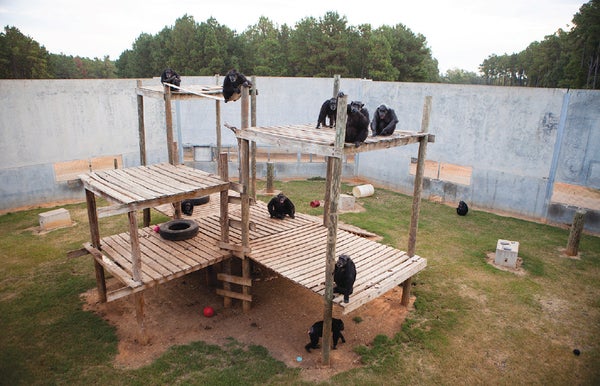
Last year Congress issued a moral call to action when it ordered the National Institutes of Health to reevaluate its ethical oversight of government-funded primate research. Although the scientific community widely sees nonhuman primates as essential for advances in biomedicine (they have facilitated major gains in the fights against AIDS and neurological diseases such as Parkinson's, for example), researchers agree more can be done to treat the animals more humanely and conduct research less wastefully. To that end, the NIH gathered prominent scientists and ethicists last September to discuss the future of primate-based research—and they agreed that data sharing is the way forward.
Researchers could reduce experiments on nonhuman primates by studying data that have already been collected to answer new questions, says David O'Connor, a pathologist at the University of Wisconsin–Madison. O'Connor is walking the walk: his laboratory studies the Zika virus in primates, and he immediately posts all the results online. The goal is to figure out ways to combat Zika as quickly as possible without placing an undue burden on research primates.
The Seattle-based Allen Institute for Brain Science, which uses rhesus macaques to study the molecular basis of brain development, also makes all results public. O'Connor says this practice should be more widespread so that “researchers who are using this scarce but vital resource can learn as much as possible from as few animals as necessary.” Still, he is skeptical that data sharing will catch on because it would require a change in “normative behavior”—science's strong culture of secrecy, in which data are kept under wraps until they are published in a peer-reviewed journal.
On supporting science journalism
If you're enjoying this article, consider supporting our award-winning journalism by subscribing. By purchasing a subscription you are helping to ensure the future of impactful stories about the discoveries and ideas shaping our world today.
One step toward full transparency is to follow the lead of human clinical trials, says Christine Grady, a bioethicist at the NIH. U.S. law requires most clinical trials to register online and make their results public, even if a study fails or is inconclusive. This ensures that other researchers can learn from a trial regardless of its results—a move that could also safeguard primates against being used for the same thing twice.
Nancy Haigwood, director of the Oregon National Primate Research Center, also says data sharing is “the way of the future.” Her center hosts 4,800 primates—including macaques, baboons and squirrel monkeys—to study a variety of human diseases. She currently contributes results from her center to O'Connor's Web site. “I don't see a downside,” she says. “We have to share data more quickly.”
