
On supporting science journalism
If you're enjoying this article, consider supporting our award-winning journalism by subscribing. By purchasing a subscription you are helping to ensure the future of impactful stories about the discoveries and ideas shaping our world today.
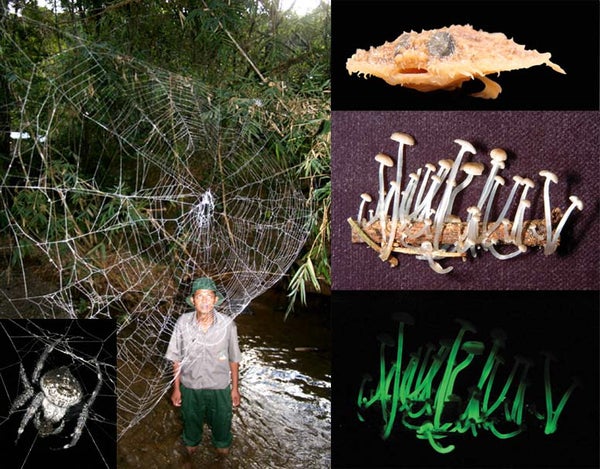
A glow-in-the-dark mushroom, a lumpy pancake-shaped fish and a spider that weaves 25-meter-wide webs are among the top 10 new species chosen by the International Institute for Species Exploration (IISE) at Arizona State University in Tempe. The lucky 10 newcomers beat out thousands of other new species discovered in the past year to win the favor of an international committee of biodiversity experts.
"Committee members had a complete freedom in making their choices and developing their own criteria, from unique attributes or surprising facts about the species to peculiar names," explained Quentin Wheeler, an entomologist and director of the IISE, in a statement.
Mycena luxaeterna [bottom right], where the genus translates to "eternal light," is a fungus named after the final movement of Mozart's Requiem. Discovered in Brazil, the tiny mushrooms are coated with a bioluminescent gel that emits a steady yellowish-green glow.
Caerostris darwini [left], named after the famous Charles, is an orb-weaving spider that likes to cast a wide net. Its supersize creations, made of silk reportedly 10 times as strong as Kevlar—twice as strong as that of any other known spider—can be found stretching across rivers, streams and lakes in Madagascar, often with dozens of prey insects entrapped.
Halieutichthys intermedius [top right], or the Louisiana pancake batfish, is a bottom-dwelling fish whose only known habitat was covered by the 2010 Gulf of Mexico oil spill. It has a huge head and mouth, tiny tail and shuffles along the seafloor on a pair of stout, armlike fins, resembling a walking bat.
Other species in the top 10 include a jumping cockroach and a six-foot-long fruit-eating lizard. The IISE selections—meant to bring attention to biodiversity and the vast quantity of unknown species that remain—are announced annually on May 23, the birthday of Carolus Linnaeus, the Swedish botanist and zoologist who is considered the father of modern taxonomy.
—Nina Bai