
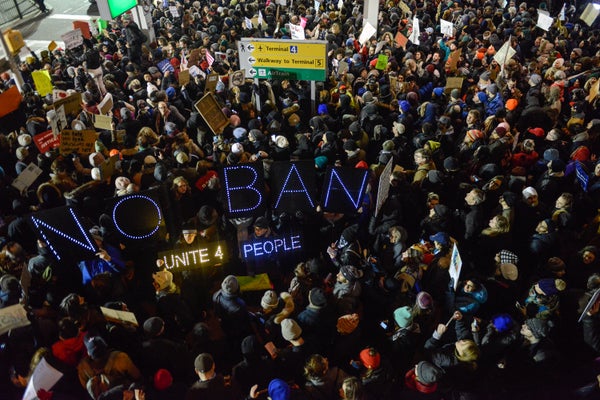
Nearly 3,000 academics, including 13 Nobel laureates, have signed a petition denouncing an executive order signed by President Donald Trump that bars people from seven Muslim-majority nations from entering the US.
Under the order, signed Friday, nationals of Iran, Iraq, Libya, Somalia, Sudan, Syria, and Yemen are prohibited from entering the US for at least 90 days, regardless of whether they have green cards or visas.
The order is discriminatory, according to the petition, whose signatories include former Nobel laureates such as past National Institutes of Health Director Dr. Harold Varmus, Linda Buck of the Fred Hutchinson Cancer Research Center, and Andrew Fire of Stanford University, and well-known Harvard psychology professor Steven Pinker. Furthermore, it threatens to seriously damage the US’s status as a world leader in scientific research, which is built in large part on the labors of immigrants, the petitioners wrote.
On supporting science journalism
If you're enjoying this article, consider supporting our award-winning journalism by subscribing. By purchasing a subscription you are helping to ensure the future of impactful stories about the discoveries and ideas shaping our world today.
“This measure is fatally disruptive to the lives of these immigrants, their families, and the communities of which they form an integral part,” the petition states. “It is inhumane, ineffective, and un-American.”
Meanwhile, the executive order has already had a chilling effect in academia. On Friday evening, the Massachusetts Institute of Technology’s international scholars department advised students from the seven affected nations to postpone any international travel for fear they might not be able to return to the US.
Read more:Scientists plan their own march on Washington
“While we do not know if official action will be taken and, if so, what that action will entail, we feel it is important to consider all appropriate precautions,” the email stated.
For Samira Asgari, a postdoctoral fellow at the Swiss Federal Institute of Technology in Lausanne, those fears became real on Saturday. Asgari was slated to fly to Boston to join Dr. Soumya Raychaudhuri’s lab at the Broad Institute. But she was denied boarding at the airport due to her Iranian nationality, Asgari said on Twitter.
Iranian scientist Seyed Soheil Saeedi Saravi is in a similar situation, as his visa was suspended days before he was to fly to the US for a research fellowship at Harvard, the New York Times reported.
Iran is a particularly fertile ground for promising academics, and more than 3,000 students from the country have received PhDs at American universities over the past three years, according to the petitioners.
Republished with permission from STAT. This article originally appeared on January 28, 2017.