
Denver, Colorado
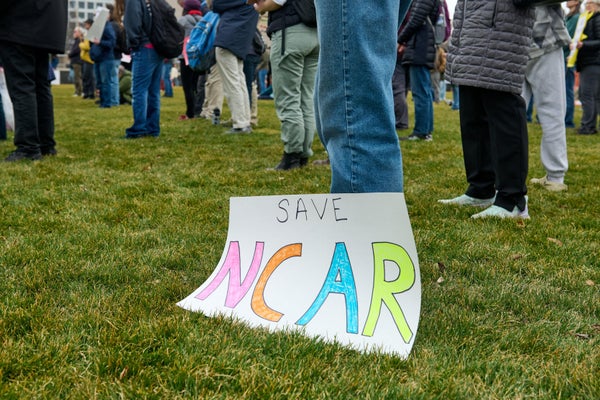
In one of the highest-profile battles yet between the US research community and the administration of President Donald Trump, lawyers faced off in a Colorado courthouse yesterday over the future of a research centre that has been called the global ‘mothership’ of climate science.
Under Trump, the US government has said that it will take steps to dismantle the National Center for Atmospheric Research (NCAR) in Boulder, Colorado, alleging that it promotes climate alarmism. The organization that manages NCAR — a coalition of around 130 universities called the University Corporation for Atmospheric Research (UCAR) — sued the government in March to stop NCAR’s break-up.
On supporting science journalism
If you're enjoying this article, consider supporting our award-winning journalism by subscribing. By purchasing a subscription you are helping to ensure the future of impactful stories about the discoveries and ideas shaping our world today.
Researchers say that NCAR is a crucial global resource whose models underpin much of modern atmospheric science, including artificial-intelligence studies aimed at decoding and predicting extreme weather. “Losing NCAR would mean losing decades of institutional knowledge, something that cannot be plugged back in two or four or even ten years from now,” says Angeline Pendergrass, an atmospheric scientist at Cornell University in Ithaca, New York.
Legal action
At the heart of the legal fight is whether the US National Science Foundation (NSF), which provides the bulk of NCAR’s funding through a contract with UCAR, is moving too quickly and without authority to hand off pieces of NCAR — including a supercomputing centre in Cheyenne, Wyoming — to public and private institutions.
A lawyer representing the NSF argued in court that no final decisions had been taken; an NSF spokesperson told Nature that he had nothing further to add.
Documents released as part of the UCAR lawsuit show that last November, the White House’s budget office told the NSF to begin restructuring NCAR to align the centre’s mission “more closely with Administration priorities”. The news became public in December. By January, the NSF asked for proposals on how NCAR should be reorganized, including a request for public comments by 13 March. But the documents show that well before that deadline arrived, on 12 February, the NSF told NCAR officials that the agency had already decided to transfer the stewardship of its supercomputing centre elsewhere. “That’s remarkably fast for a consequential decision such as this,” says Carlos Javier Martinez, a climate scientist at the Union of Concerned Scientists in Cambridge, Massachusetts.
On 3 April, UCAR asked a US district court judge to freeze the plans to give away the supercomputing centre. “This is a sham process,” Michael Purpura, a solicitor at the Hueston Hennigan law firm in Newport Beach, California, argued on UCAR’s behalf at the 7 May court hearing.
Representing the NSF, solicitor Marianne Kies argued that despite the actions taken so far, the agency had not made any decisions on the future of the supercomputing centre or the rest of NCAR. “A final decision has not been made to transfer stewardship,” said Kies, who works with the US Department of Justice in Washington DC. “It’s not the case that NSF failed to follow procedure — it’s just that the need to follow procedure has not been triggered yet.”
The judge, R. Brooke Jackson of the US District Court of Colorado, told both sides that he would issue a decision “as promptly as possible.” If he finds in favour of the NSF, the process of handing off the supercomputing centre will carry on. If he finds in favour of UCAR, that transfer is likely to be put on hold until the parties work out some other arrangement. Whatever the ruling, the broader battle over the future of NCAR — including its aeroplane fleet, space-weather studies and climate-modelling teams — will probably continue to play out.
Scientists and other people who use NCAR data could see “ripple effects” caused by the current uncertainty, including on weather forecasts and the people who rely on them, says Amanda Staudt, executive director of the American Meteorological Society in Boston, Massachusetts. “Major changes like those proposed by NSF can be very disruptive.”
An uncertain future
The NSF created NCAR in 1960 at the request of US universities that wanted a shared centre for atmospheric research but did not have the resources to support such a centre on their own. NCAR currently operates under a five-year, US$938-million contract between UCAR and the NSF that ends in 2028.
Members of the US Congress from Colorado have been trying to stop any moves towards breaking up NCAR, but so far have not succeeded. One possible strategy could be for Congress, which controls government spending, to add language into upcoming funding legislation that directs the NSF to keep NCAR intact.
In the hearing, UCAR argued that there has already been substantial harm to NCAR in the form of a ‘brain drain’. Scientists have been leaving the atmospheric research centre because of uncertainty around its future. Kies, representing the government, argued that any such departures have been premature because no “final agency action” has been taken.
The leading candidate to take over the supercomputing centre is the University of Wyoming in Laramie, which already partners with NCAR to run the facility. The centre includes a supercomputer named Derecho, which began operations in 2023. Since then, it has been used to study phenomena such as wildfire spread and severe storms.
It’s “puzzling” that the NSF would invest millions of dollars into a new supercomputer in 2023, around the same time the agency renewed UCAR’s contract, showing confidence in the consortium, Martinez says. “And now, we see all of this change,” he adds. “It begs the question of, why?”
This article is reproduced with permission and was first published on May 8, 2026.