
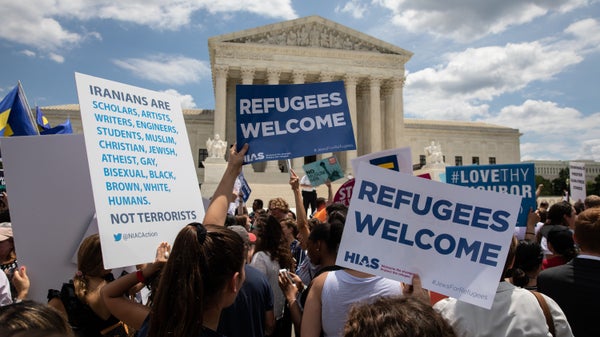
U.S. President Donald Trump’s policy to ban travelers from five Muslim-majority countries is lawful, the U.S. Supreme Court said on 26 June. The 5-4 ruling comes after several lower courts had acted to limit or suspend the policy, which Trump introduced in January 2017.
The original ban had immediate repercussions for researchers from Iran, Iraq, Libya, Somalia, Sudan, Syria and Yemen—stranding several in transit and preventing others from coming to the United States to work, study or attend scientific meetings. The White House has since revised the policy. It now applies to travelers from five majority-Muslim nations—Iran, Libya, Syria, Yemen and Somalia—plus Venezuela and North Korea.
The travel restrictions now vary by country, and include some exemptions for students. But data from the Department of Justice reveal that the government issued just 289 visas to students from Iran, Libya, Yemen and Somalia in the first three months of this year. “This is less than a quarter of the volume needed to be on track for 2016 student visa levels,” the last full year before the ban took effect, Justice Stephen Breyer noted in his dissenting opinion.
On supporting science journalism
If you're enjoying this article, consider supporting our award-winning journalism by subscribing. By purchasing a subscription you are helping to ensure the future of impactful stories about the discoveries and ideas shaping our world today.
The court’s ruling came on a challenge to the third version of the travel ban, which Trump issued in September 2017. The lawsuit was filed by the University of Hawaii, along with individuals and a Muslim-advocacy group; they contended that the policy amounted to discrimination based on religion. Several universities and higher-education groups have been vocal in opposing the travel ban in all its versions, arguing that the policy would create an unwelcoming environment for international scholars.
But a majority of Supreme Court justices rejected the idea that the ban was premised on religious discrimination. Instead, Chief Justice John Roberts wrote that the policy is justified on national-security grounds. He noted that the Trump administration had amended the original ban to include North Korea and Venezuela—countries without significant Muslim populations—and had allowed people from Iraq and Sudan to enter the United States after their home countries changed certain security-screening procedures.
But in a dissenting opinion, Justice Sonia Sotomayor argued that the ban “was driven primarily by anti-Muslim animus,” citing several statements by Trump—including his oft-repeated campaign promise to bar Muslims from entering the United States. While the travel ban itself may not have enormous implications for science, it is symptomatic of the Trump administration’s approach to foreign policy, says Russell Harrison, a senior legislative representative for IEEE-USA in Washington DC. “A lot of foreigners are concluding that the United States is no longer interested in people who were not born here," he says. “And that is a big problem.”
This article is reproduced with permission and was first published on June 26, 2018.