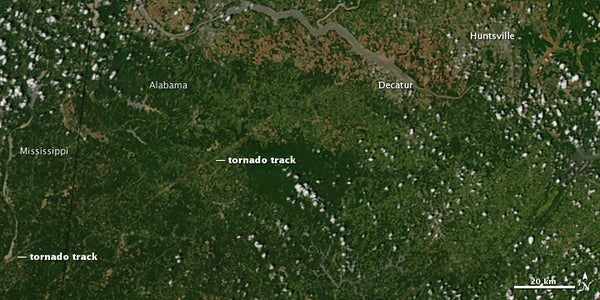
A devastating cluster of tornadoes that hit the southern U.S. between April 25 and 28 left tracks large enough to be seen by satellite.
NASA MODIS Rapid Response Team, Jeff Schmaltz
Join Our Community of Science Lovers!
On supporting science journalism
If you're enjoying this article, consider supporting our award-winning journalism by subscribing. By purchasing a subscription you are helping to ensure the future of impactful stories about the discoveries and ideas shaping our world today.
A devastating cluster of tornadoes that hit the southern U.S. between April 25 and 28 left tracks large enough to be seen by satellite. This image, taken by NASA's Aqua satellite on April 28, shows two brown paths cleared of vegetation and cutting through Smithville, Miss., (bottom left) and northwestern Alabama (center).
The National Weather Service rated the Smithville storm at EF5, which means it was strong enough to collapse a concrete building, according to NASA Earth Observatory. That storm killed at least 14 people. The tornado in the Alabama track was rated at EF4 and killed more than 20 people. Its path is about 12 miles long.
The overall late April storm system created an estimated 305 tornadoes, the greatest number of tornadoes on record for one event, according to the National Oceanic and Atmospheric Administration. Tornadoes across seven states killed 342 people and several hundred are missing, according to MSNBC.
—Francie Diep
It’s Time to Stand Up for Science
If you enjoyed this article, I’d like to ask for your support. Scientific American has served as an advocate for science and industry for 180 years, and right now may be the most critical moment in that two-century history.
SciAm always educates and delights me, and inspires a sense of awe for our vast, beautiful universe. I hope it does that for you, too.
If you subscribe to Scientific American, you help ensure that our coverage is centered on meaningful research and discovery; that we have the resources to report on the decisions that threaten labs across the U.S.; and that we support both budding and working scientists at a time when the value of science itself too often goes unrecognized.