
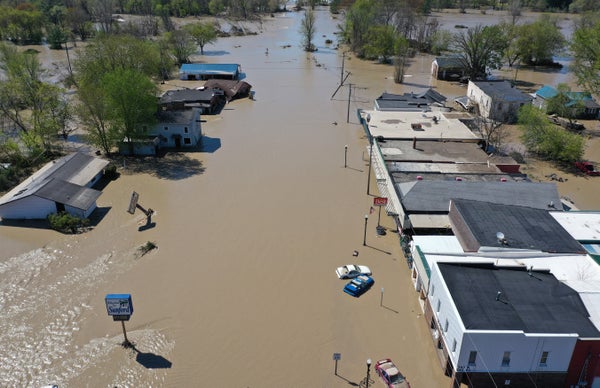
Catastrophic flooding in Michigan yesterday was a harbinger of climate change as Rust Belt cities are thrust into the crosshairs of intensifying disasters, experts say.
The dangers of extreme weather, like the deluge in Midland, are rising in frequency and intensity across the Midwest. It speaks to underlying climate conditions such as heavier downpours that drive up the risk of flooding, experts say.
“This is a tragic event for Midland, and I don’t want to belittle it,” said Drew Gronewold, a hydrologist and associate professor of environment and sustainability at the University of Michigan. “But it’s important that we broaden the context. This entire region is saturated right now, and we have been seeing this wet cycle in the Upper Great Lakes for five years.”
On supporting science journalism
If you're enjoying this article, consider supporting our award-winning journalism by subscribing. By purchasing a subscription you are helping to ensure the future of impactful stories about the discoveries and ideas shaping our world today.
In Midland’s case, nearly 5 inches of rain fell across a region that couldn’t absorb it, leading the Tittabawassee River to breach a hydroelectric dam and overtop another. The larger structure, called Edenville Dam, lost its operating license in 2018 for noncompliance of federal rules; there were concerns it could not withstand a major flood.
The torrent forced roughly 10,000 people to evacuate and inflicted extensive damage on property and infrastructure. It also flowed through a sprawling Dow Chemical Co. complex and adjacent Superfund site along the Tittabawassee, where Dow dumped liquid wastes into the river. A Dow spokesman said in a statement that the company was working to contain floodwater on its property.
Richard Norton, a professor of urban and regional planning at the University of Michigan, said extreme weather events in older cities like Midland “highlight how much added risk we’re facing because of our industrial past, which placed so many high-risk critical facilities and high-contamination industrial sites so close to waterways now at increased risk of flooding. It’s a double whammy.”
Norton suggested that the probability of extreme events will increase.
While Midland’s flood “is about the most extreme ... a community might experience, they will become much less extreme over time — both in terms of how frequently they happen and how damaging they are when they do happen,” he said.
Yet even as changing climate conditions undergirded nearly every component of this week’s disaster, elected officials and residents often don’t see the connection to rising temperatures, experts say.
“This is historic for us. People think they’ve dealt with the same flood over and over again, but these are bigger floodwaters than we ever could have imagined,” said Selina Tisdale, community affairs director for the city of Midland (Greenwire, May 20). “I think if people underestimated or thought they knew what they were dealing with, this may have caught them a little off guard.”
At a press briefing last night, Midland County Administrator Bridgette Gransden referred to the disaster as “a 500-year flood” and that officials “couldn’t have predicted exactly what has happened here today.” The county did perform a recent disaster exercise based on a dam failure at Edenville.
Jenifier Boyer, the county’s emergency management coordinator, said Midland’s hazard mitigation plan accounts for a variety of events, including floods. But to date, climate change has not been factored into risk management planning. Boyer said climate will be a focus of an upcoming review of the plan.
“Part of the reason why we started doing a lot of this [disaster] exercising and reviews is because we have been seeing more significant heavy rain events and they have been very widespread,” she said. But, she added, “There’s nothing we can do about them. It’s just part of Mother Nature.”
But experts and environmental groups say communities like Midland must accept the realities of climate change and its role in worsening disasters.
“This is not an isolated incident,” Bob Irvin, president and CEO of the nonprofit group American Rivers, said in a statement. “Climate change is bringing more severe flooding, at a time when our nation’s infrastructure is crumbling.”
Reprinted from Climatewire with permission from E&E News. E&E provides daily coverage of essential energy and environmental news at www.eenews.net.