
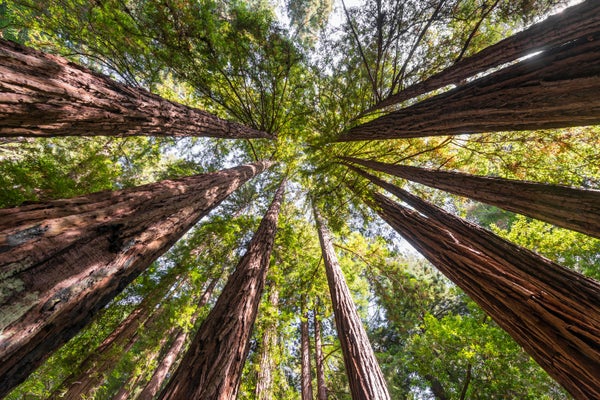
California's coastal redwoods, Sequoia sempervirens, are the tallest trees on earth. But measuring their precise dimensions—which is key to determining how much climate-altering carbon they store as biomass—is fraught with uncertainty. Widely used scaling equations between trunk diameter and volume are based on limited sampling of much smaller trees, given that few people are willing to don a climbing harness and take measurements 30 stories off the ground. Now, for the first time, researchers have surveyed S. sempervirens using laser scanning, an automated technique that yields accurate measurements of a tree's structure and volume.
Mathias Disney, an environmental scientist at University College London, and his colleagues assessed 145 redwoods for a study published in Scientific Reports. They fired billions of near-infrared laser pulses at the trees from multiple directions, recording the time it took the pulses to bounce back. This process let them assemble a detailed map of each tree, showing burrs, twigs and other features as small as a few centimeters. “This is giving us a new perspective on the three-dimensional structure of trees,” Disney says.
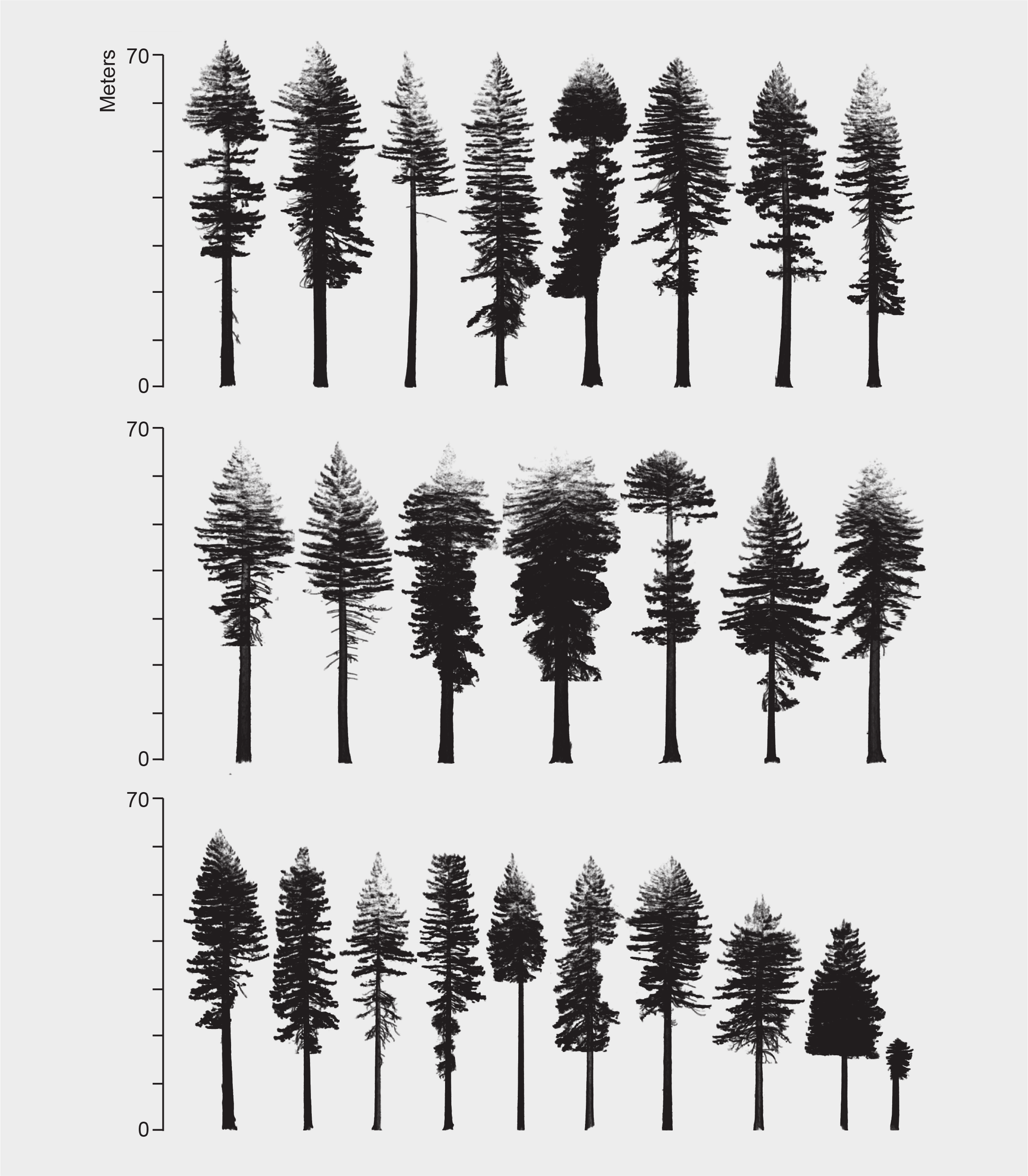
Credit: From “New 3D Measurements of Large Redwood Trees for Biomass and Structure,” by Mathias Disney et al., in Nature Scientific Reports, Vol. 10; October 15, 2020
On supporting science journalism
If you're enjoying this article, consider supporting our award-winning journalism by subscribing. By purchasing a subscription you are helping to ensure the future of impactful stories about the discoveries and ideas shaping our world today.
The researchers found that coastal redwoods tended to be about 30 percent larger by volume than published scaling relations predicted. The authors suggest this discrepancy might be because some S. sempervirens sprout additional trunks as they age, a process called reiteration. Based on their observations, Disney and his colleagues have established new scaling relations between tree diameter and volume for the species.
Laser scanning can increase knowledge of old-growth forests that is important in conservation efforts, says Anil Raj Kizha, a forest operations scientist at the University of Maine, who was not involved in the research. “In the coming five to 10 years,” he says, “this is going to be more widespread.”