
Recent summer temperatures in parts of Australia were high enough to melt asphalt. As global warming cranks up the heat and climatic events intensify, many plants may be unable to cope. But at least one species of eucalyptus tree can withstand extreme heat by continuing to “sweat” when other essential processes taper off, a new study finds.
As plants convert sunlight into food, or photosynthesize, they absorb carbon dioxide through pores on their leaves. These pores also release water via transpiration, which circulates nutrients through the plant and helps cool it by evaporation. But exceptionally high temperatures are known to greatly reduce photosynthesis—and most existing plant models suggest this should also decrease transpiration, leaving trees in danger of fatally overheating. Because it is difficult for scientists to control and vary trees' conditions in their natural environment, little is known about how individual species handle this situation.
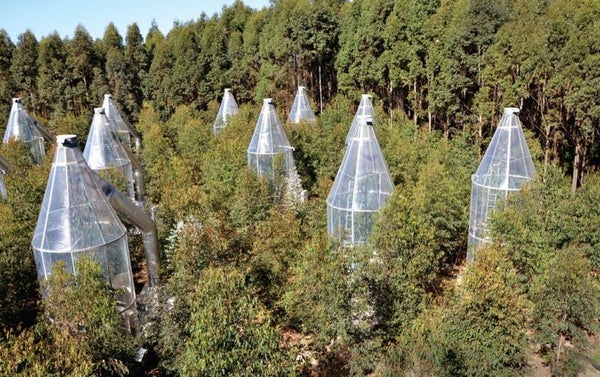
Ecologist John Drake of the S.U.N.Y. College of Environmental Science and Forestry and his colleagues grew a dozen Parramatta red gum (Eucalyptus parramattensis) trees in large, climate-controlled plastic pods that isolated the trees from the surrounding forest for a year in Richmond, Australia. Six of the trees were grown at ambient air temperatures and six at temperatures three degrees Celsius higher. The researchers withheld water from the surface soil of all 12 trees for a month to simulate a mild dry spell, then induced a four-day “extreme” heat wave: They raised the maximum temperatures in half of the pods (three with ambient temperatures and three of the warmer ones)—to 44 degrees C.
On supporting science journalism
If you're enjoying this article, consider supporting our award-winning journalism by subscribing. By purchasing a subscription you are helping to ensure the future of impactful stories about the discoveries and ideas shaping our world today.
Photosynthesis ground to a near halt in the trees facing the artificial heat wave. But to the researchers' surprise, these trees continued to transpire at close-to-normal levels, effectively cooling themselves and their surroundings. The trees grown in warmer conditions coped just as well as the others, and photosynthesis rates bounced back to normal after the heat wave passed, Drake and his colleagues reported online in February in Global Change Biology.
The researchers think the Parramatta red gums were able to effectively sweat—even without photosynthesis—because they are particularly good at tapping into water deep in the soil. But if a heat wave and a severe drought were to hit at the same time and the groundwater was depleted, the trees may not be so lucky, Drake says.
Other scientists call the finding encouraging. “It's definitely good news,” says Trevor Keenan, an ecologist at Lawrence Berkeley National Laboratory, who was not part of the study. “It would be very interesting to know how this translates to other species,” he adds. Drake hopes to conduct similar experiments with trees common in North America.