
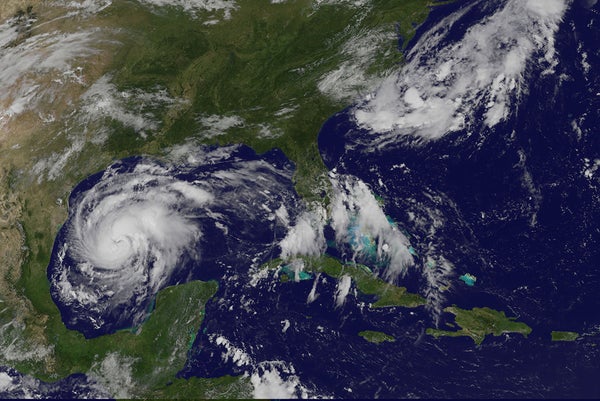
SAN ANTONIO (Reuters) - The Texas Gulf Coast was bracing for Tropical Storm Harvey to make landfall by Friday, bringing with it powerful winds, torrential rains and the possibility that it could strengthen into a hurricane.
Harvey was about 370 miles (595 km) southeast of Port Mansfield, Texas, by early Thursday as it moved across the Gulf of Mexico with maximum sustained winds of 45 miles (72 km) per hour, the U.S. National Hurricane Center (NHC) said.
U.S. benchmark gasoline prices RBc1 hit a three-week high on Thursday as the storm took aim at the center of the country's refining industry.
On supporting science journalism
If you're enjoying this article, consider supporting our award-winning journalism by subscribing. By purchasing a subscription you are helping to ensure the future of impactful stories about the discoveries and ideas shaping our world today.
The storm has also forced energy companies including Royal Dutch Shell (RDSa.L), Anadarko Petroleum (APC.N) and Exxon Mobil (XOM.N) to evacuate staff from oil and gas platforms in the Gulf of Mexico.
Hurricane, tropical storm and storm surge watches were in effect for counties along the Gulf Coast.
The biggest threat from Harvey is not its strong winds but the heavy rain, according to NHC forecaster Dennis Feltgen.
Most at risk from floods are the Houston area and the Coastal Bend, a region which includes Corpus Christi.
“We may be measuring rainfall in feet rather than inches,” he said. “This is a potentially life threatening flooding situation.”
Winds up to 75 mph (120 kph) and as much as 15 inches of rain (38 cm) were forecast, the National Weather Service said on Thursday.
Harvey may strengthen into a hurricane by the time it makes landfall near Corpus Christi, it said.
Corpus Christi Mayor Joe McComb said on Wednesday that flooding was his biggest concern.
The city, which is a major oil refining center, has not issued any evacuation orders, he told reporters at a news conference, but its emergency operations center has been activated.
“I hope people will listen to forecasters when they say 'beware of flash floods,'” McComb said. “Flash floods can come quickly, and they can be deadly.”
Texas Governor Greg Abbott declared a state of disaster on Wednesday for 30 counties, authorizing the use of state resources to prepare for the storm.
Coastal cities and counties distributed sandbags to residents as some businesses boarded up windows, and residents flocked to grocery stores to stock up on supplies, local media reported.
Texas A&M University-Corpus Christi issued a mandatory evacuation to all students who live on campus and canceled events.