
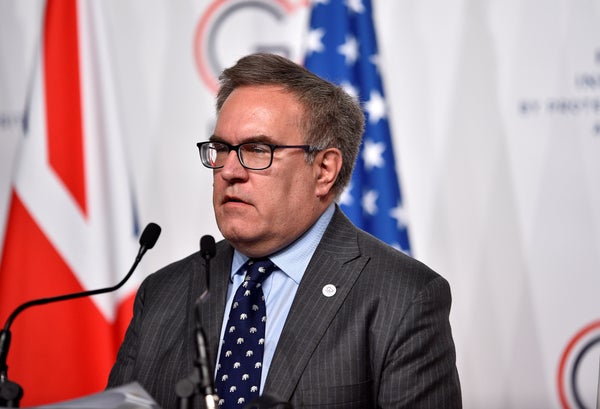
EPA Administrator Andrew Wheeler used an overseas gathering of environment ministers this week to hint that the United States might overhaul the way it uses climate data and modeling. Five days after his assertion was included in an official document from the Group of Seven meeting in Metz, France, it remains unclear if Wheeler revealed a potential policy to reexamine climate modeling.
It’s become common for the United States to have its own climate and energy paragraph in multilateral statements, and on Monday, Wheeler broke away from the six other nations on issues like the Paris Agreement, providing support for poor and climate-affected countries, and overseas investments in fossil fuels.
That much was normal. It’s happened ever since President Trump took office in January 2017.
On supporting science journalism
If you're enjoying this article, consider supporting our award-winning journalism by subscribing. By purchasing a subscription you are helping to ensure the future of impactful stories about the discoveries and ideas shaping our world today.
But Wheeler added something new that’s raising concern among some environmentalists that the United States might be formally questioning climate science inside federal agencies.
“The United States reaffirms its commitment to re-examine comprehensive modeling that best reflects the actual state of climate science in order to inform its policy-making decisions, including comparing actual monitored climate data against the modeled climate trajectories on an on-going basis,” says the U.S. portion of the communiqué.
Greens who follow the G-7 process were dismayed.
Alden Meyer, director of policy and strategy at the Union of Concerned Scientists, called the language “pretty troubling,” and Luca Bergamaschi of the Britain-based E3G called it “a major step back.”
They read Wheeler’s language as an attempt to undercut a report last year by the U.N. Intergovernmental Panel on Climate Change. The report drew on thousands of peer-reviewed studies to warn of the importance of holding postindustrial warming to no more than 1.5 degrees Celsius.
Wheeler has been critical of the IPCC’s conclusions and of the National Climate Assessment, a U.S. report that issued similar warnings last year. He’s not alone in the Trump administration. In December, U.S. delegates to the U.N. climate talks in Katowice, Poland, joined Russia and Saudi Arabia to block language to “welcome” the IPCC’s findings.
It’s unclear if Wheeler meant to slight the IPCC on Monday. In fact, he joined his counterparts from France, Canada, the United Kingdom, Italy, Germany and Japan in praising the international body’s work to “strengthen the science-policy interface on the environment including by providing reliable assessments of the state of knowledge in response to the requests of policy makers and build capacity to use science effectively in decision-making at all levels.”
The statement leaves little to “re-examine” from the IPCC’s work.
So, was he announcing an alternative climate modeling initiative, either at EPA or another federal agency?
“Currently, there are no specific efforts underway at EPA,” said agency spokesman James Hewitt. He didn’t respond to follow-ups about future plans or initiatives at other agencies.
Meyer and others suggested that Wheeler might be referring to plans within the White House to convene a task force within the National Security Council to undermine the scientific underpinnings of the National Climate Assessment. But that proposal—to be spearheaded by William Happer, a senior director on the National Security Council—has yet to be accepted by Trump. NSC didn’t respond to inquiries (Climatewire, Feb. 21).
Myron Ebell, a senior fellow at the Competitive Enterprise Institute, said a White House meeting last week to brief the president on the Happer proposal “went well.” But he said the concept remains controversial among some senior officials.
“The president is enthusiastic about setting up the Happer commission,” said Ebell, who oversaw the EPA transition team before Trump’s inauguration. But he noted that Wheeler would have been unlikely to reference a program that Trump has yet to bless at an international forum.
Reprinted from Climatewire with permission from E&E News. E&E provides daily coverage of essential energy and environmental news atwww.eenews.net.