
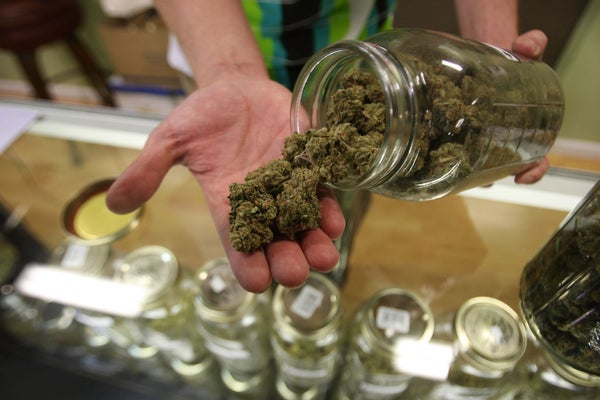
On Thursday the Trump administration officially reclassified state-licensed medical marijuana products under the Controlled Substances Act (CSA). The move removes these products from the Schedule I category, which includes what the government considers to be high-risk and dangerous drugs such as heroin, LSD and ecstasy, to the lower-risk category of Schedule III. The change applies to state-regulated medical marijuana and does not legalize medical or recreational cannabis products on the federal level.
The move could also make cannabis far easier for researchers to study. According to the U.S. Drug Enforcement Administration, under the CSA, the Schedule I classification includes drugs with “no currently accepted medical use and a high potential for abuse.” For researchers studying marijuana, the drug’s Schedule I listing added sometimes insurmountable hurdles to their work, such as extra paperwork and expensive safety procedures. Schedule III, meanwhile, applies to drugs, such as ketamine and anabolic steroids, that the government deems to have “a moderate to low potential for physical and psychological dependence”—that means they carry far lower barriers to study.
“The Department of Justice is delivering on President [Donald] Trump’s promise to expand Americans’ access to medical treatment options,” said acting attorney general Todd Blanche in a statement. “This rescheduling action allows for research on the safety and efficacy of this substance, ultimately providing patients with better care and doctors with more reliable information.”
On supporting science journalism
If you're enjoying this article, consider supporting our award-winning journalism by subscribing. By purchasing a subscription you are helping to ensure the future of impactful stories about the discoveries and ideas shaping our world today.
In the same statement, the administration said that the move is just the start of an “expedited administrative hearing process” aimed at rescheduling cannabis from Schedule I to Schedule III broadly—marijuana has been classified as a Schedule I drug for more than 55 years. It follows a December 2025 executive order from President Trump that aimed to increase medical marijuana research.
“Under the direction of President Trump and Acting Attorney General Blanche, DEA is expeditiously moving forward with the administrative hearing process—bringing consistency and oversight to an area that has lacked both,” said DEA administrator Terry Cole in the same statement. “Our men and women in law enforcement remain committed to fighting drug cartels, the fentanyl epidemic, and protecting American lives.”
The effort to change marijuana from Schedule I to Schedule III represents “a pretty significant shift” at the federal level, says Staci Gruber, an associate professor of psychiatry at Harvard Medical School. “First and foremost, it recognizes that cannabis has accepted medical use. That's a big shift.”
“The perception and stigma that has been associated with Schedule I classification for cannabis is a different story at this point,” Gruber says.
Editor’s Note (4/23/26): This is a breaking news story and may be updated.