
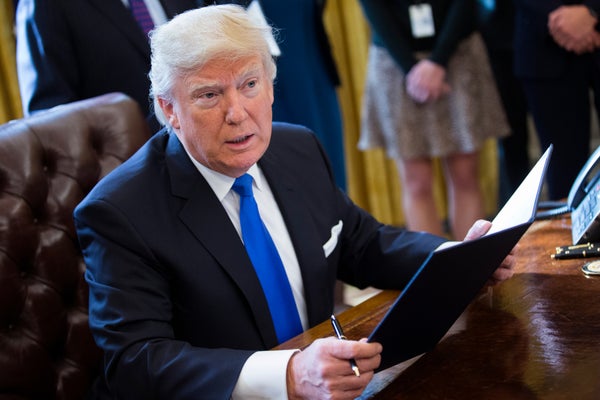
Pres. Donald Trump’s administration moved quickly this week to shore up its control over communications with the public and the press, as officials at the Environmental Protection Agency and the U.S. Department of Agriculture e-mailed staff to inform them that they may no longer discuss agency research or departmental restrictions with anyone outside of the agency—including news media. Both agencies also told their scientists and other staff that press releases and external communications about taxpayer-funded work would stop until further notice. It remains unclear if these will be temporary or long-term policies.
The Huffington Post and BuzzFeed News were the first to report the internal memos, which they said contained the EPA prohibitions on press releases and blog posts as well as the news that all incoming media requests would be carefully screened and require approval.
At the USDA a department-wide e-mail from the chief of staff of the agency’s in-house research office, the Agricultural Research Service, reportedly said the ARS would no longer release any “public-facing documents.” The e-mail, obtained by BuzzFeed, was cited as saying: “This includes, but is not limited to, news releases, photos, fact sheets, news feeds and social media content.”
On supporting science journalism
If you're enjoying this article, consider supporting our award-winning journalism by subscribing. By purchasing a subscription you are helping to ensure the future of impactful stories about the discoveries and ideas shaping our world today.
The latest actions are not entirely unprecedented. The George W. Bush administration was notorious for limiting press access to federal scientists, and although former Pres. Barack Obama came into office pledging unprecedented transparency and openness with the press, many felt his administration did not completely live up to that promise; it drew media criticism for frequently making press calls only available “on background” (meaning officials must be quoted anonymously), and using close-hold embargo policies.
Neither the USDA nor EPA immediately responded to a request for comment. Also on Monday the Trump administration announced that federal contracts and grants would be temporarily frozen at the EPA. Trump additionally signed an executive order instituting a hiring freeze for many federal workers across its agencies (although it carved out exemptions for military, national security or public safety positions).
The administration’s latest actions resemble steps taken in Canada by former Prime Minister Stephen Harper while in office from 2006 to 2015; his administration blocked government scientists from speaking with media and explaining their research. Several weeks before Trump’s inauguration, Canadian scientists interviewed by Scientific American warned their U.S. counterparts about the threat of similar restrictions.
“There was a feeling that the government was not interested in expert opinion, and I think it’s the same kind of thing that you are probably going to see with the new [Trump] administration” in the U.S., David Tarasick, a senior research scientist at Environment and Climate Change Canada (the equivalent of the U.S. Environmental Protection Agency), said last month. Harper’s move drove some Canadian scientists to leave the country to pursue their research. After Harper was voted out Canadian federal scientists last year worked with their union to ensure their contracts would enshrine their ability to speak with the media and the public about their work.