
WASHINGTON—President Trump, breaking a tradition that stretches back nearly two decades, will not personally greet the eight American Nobel laureates this year before they travel to Sweden in December to receive their prizes.
Not all the honorees are disappointed.
Two American Nobel Prize winners, when contacted by STAT, indicated they would not have attended a White House event even if invited. Columbia biophysicist Joachim Frank, awarded a Nobel in chemistry for his work in microscopy, said in an email he was “very relieved” when he learned there was no chance of an encounter with the president.
On supporting science journalism
If you're enjoying this article, consider supporting our award-winning journalism by subscribing. By purchasing a subscription you are helping to ensure the future of impactful stories about the discoveries and ideas shaping our world today.
“I will not put my foot into the White House as long as Trump, Pence, or Ryan (i.e., the possible succession of impeachments) will occupy it,” Frank said. “I cannot speak for the others; don’t know them personally yet, but I strongly believe that as thinking intelligent people they will have a similar attitude as I.”
Trump returns from a two-week trip to Hawaii and Asia on Tuesday. A White House spokesman cited the foreign travel when asked why the president would not greet the laureates in person.
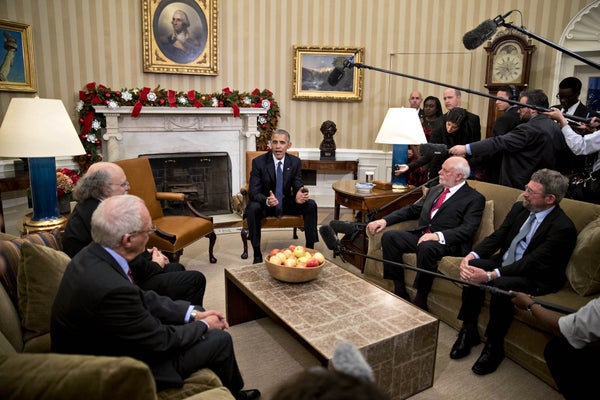
The White House has hosted an event in the laureates’ honor nearly every year since 2001. Former President Barack Obama granted an audience to the American group each year of his presidency except for 2009, when he was awarded a Nobel Peace Prize.
Former President George W. Bush attended each year except for 2006, when former Vice President Dick Cheney greeted the group instead. Former President Bill Clinton also held in-person greetings for Nobel winners on numerous occasions during his presidency.
The majority of this year’s U.S. laureates are expected to attend an event in their honor at the Swedish Embassy in Washington on Tuesday night—an event that is typically scheduled with the American president’s availability in mind.
The White House spokesman said Michael Kratsios, Trump’s top political appointee in the Office of Science and Technology Policy, will attend the reception at the Swedish Embassy on the administration’s behalf. France Cordova, the director of the National Science Foundation and an annual presence at the embassy’s event, will attend as well.
An official from the Obama administration who worked to coordinate the annual Nobel events said that last year the embassy postponed the reception to December after Obama scheduled a pre-Thanksgiving trip to Europe and South America.
Laureates have in the past used their access to the president as a political platform. In 2001, a group of American scientists wrote to Bush in opposition to his administration’s policy banning research that used embryonic stem cells. Numerous past Nobel winners in physics wrote Bush in 2008 to oppose a cut to research funding enacted that year by Congress.
The break from tradition comes as Trump, nearly 10 months after his inauguration, has yet to appoint a top science adviser and OSTP director—the longest such vacancy since OSTP was established in 1973.
A White House spokesperson also indicated the administration will not follow through with its plans, at least this year, to continue the tradition of a White House Science Fair.
The Americans awarded Nobel Prizes in 2017 are: Frank; physicists Rainer Weiss, Barry Barish, and Kip Thorne; geneticists Jeffrey C. Hall, Michael Rosbash, and Michael W. Young; and economist Richard Thaler.
Republished with permission from STAT. This article originally appeared on November 13, 2017