
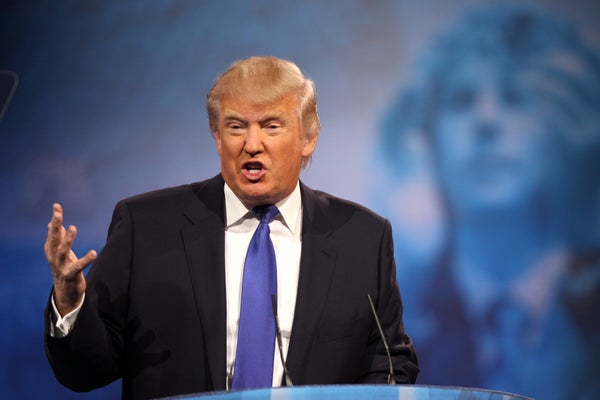
President Trump argued yesterday that the true threat to national security is not climate change but regulations that get in the way of U.S. economic and energy "dominance."
Trump introduced his first National Security Strategy, in which he broke from the Obama administration in not listing climate change as a chief threat. His remarks at times sounded like an economic address, frequently veering into discussion of tax and trade, industrial deregulation, and a celebration of the stock market. Trump insisted that wealth and national security go hand in hand.
"Economic vitality, growth and prosperity at home is absolutely necessary for American power and influence abroad," he said in an address that heavily focused on global competition over cooperation.
On supporting science journalism
If you're enjoying this article, consider supporting our award-winning journalism by subscribing. By purchasing a subscription you are helping to ensure the future of impactful stories about the discoveries and ideas shaping our world today.
"Any nation that trades away its prosperity for security will end up losing both," he added, seeming to echo Benjamin Franklin's famous remarks about liberty.
It was a sentiment that permeated the 56-page security strategy, and in particular the section titled "Embrace Energy Dominance," which dealt with energy and climate issues.
"Access to domestic sources of clean, affordable, and reliable energy underpins a prosperous, secure, and powerful America for decades to come," the document says.
National security adviser H.R. McMaster oversaw the strategy's preparation with input from staff, including White House political personnel. The energy section is similar to themes espoused by White House energy adviser George David Banks, who at climate talks in Bonn, Germany, sought to demonstrate how the U.S. could use its continued involvement in the United Nations climate process to advance a domestic energy agenda.
"U.S. leadership is indispensable to countering an anti-growth energy agenda that is detrimental to U.S. economic and energy security interests," the strategy document reads.
Climate change, meanwhile, is treated as a parenthetical.
"The United States will remain a global leader in reducing traditional pollution, as well as greenhouse gases, while expanding our economy," it states, clarifying that those gains won't be due to "onerous regulation."
But Trump's speech showed his views had changed little from the Rose Garden speech he made on June 1, in which he announced that the U.S. would withdraw from the Paris Agreement. He blasted past presidents yesterday for agreeing to "put American energy under lock and key."
"They surrendered our sovereignty to foreign bureaucrats in faraway and distant capitals," he said.
Sherri Goodman, a member of the Center for Climate and Security's Advisory Board, said Trump's dismissal of climate change was misguided and could undermine U.S. competitiveness.
Trump pledged to use all of the tools of statecraft to protect U.S. interests.
"Those tools of statecraft in my view include both climate and energy strategies, and to ignore one that's staring us right in the face is not to fully recognize some of the key challenges that we face," Goodman said.
When it comes to the non-fossil-fuels energy industries that are set to expand in the 21st century, Goodman said, "China is eating our lunch."
"Why are we giving away our economic leadership by failing to pursue some of the greatest economic and clean energy opportunities that are right in front of us and that our great land of innovation has the ability to make us global leaders on?" she asked.
The document does tout U.S. natural gas "innovation," offering it as a hedge against coercion by other gas-producing nations. Stephen Hadley, a former U.S. national security adviser now in private practice, commended the administration for this new focus on innovation.
"I think that's very strong," he said on a conference call with reporters.
The National Security Strategy is regarded more as a political statement than a policy driver. And some experts questioned how important it would be, given that little is expected of the Trump presidency when it comes to climate change.
Congress passed and the president signed a defense authorization bill last week naming climate change a threat to national security, and the Defense Department's policy guidance affirms the need to consider the impacts of warming. Secretary of Defense James Mattis stated during his Senate confirmation process in March that climate change "is impacting stability in areas of the world where our troops are operating today." Trump said yesterday his strategy has the backing of the whole Cabinet.
The Quadrennial Defense Review and the defense authorization law have deeper impacts on policy than the National Security Strategy, said retired Rear Adm. David Titley.
"The administration's National Security Strategy won't stop Arctic ice from melting. It will continue to melt at an increasing rate, and our national security leaders know that we need to address it as we manage many other risks from climate change," said Titley, a former oceanographer for the Navy who now directs the Center for Solutions to Weather and Climate Risk at Pennsylvania State University.
"Climate change impacts here and abroad are now recognized by our national security leadership as 'facts on the ground,' and this will continue even if they aren't explicitly recognized in the NSS," he added.
Military brass has incorporated climate change preparation into its mindset, said Andrew Holland, senior fellow for energy and climate at the American Security Project. The National Security Strategy won't tear that out by the root, he said.
"The National Security Strategy is a political document put out by the White House. It's almost as if that's how the administration is going to deal with the world, as they want it to be," Holland said. "The top-ranking individual who has a position on this is Secretary Mattis, and he's said climate change is real, it's happening and we have to plan for it, we have to prepare for it."
Francesco Femia, co-president of the Center for Climate and Security, said Trump's omissions on climate would send a message to the world that the U.S. might not engage in discussions on warming now underway.
"I do think it's a negative signal and could have some implications for our partners and allies abroad," he said.
Meetings were held last week in The Hague, Netherlands, and at U.N. headquarters over how the U.N. Security Council might incorporate climate change into its agenda. Another meeting is set for this week in New York. The U.S. has a permanent seat on the council but has been absent from those meetings, and Femia said yesterday's security strategy could show U.S. indifference to an issue of importance to some allies.
Reporter Zack Colman contributed.
Reprinted from Climatewire with permission from E&E News. E&E provides daily coverage of essential energy and environmental news at www.eenews.net.
