
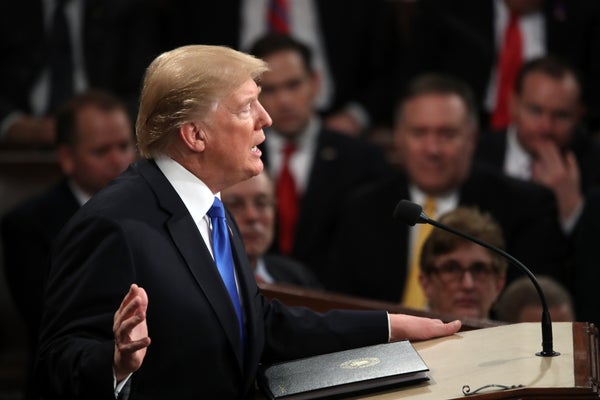
WASHINGTON—In a wide-ranging State of the Union address Tuesday evening, President Trump endorsed Congress’s efforts to pass a bill allowing access to experimental treatments for patients with terminal conditions.
So-called “right-to-try” legislation was passed by the Senate last fall, but the effort has since stalled in the House. Vice President Mike Pence has endorsed a right-to-try bill. In February Trump gave his support to the legislation but he had not spoken publicly about the issue prior to Tuesday’s address.
“We also believe that patients with terminal conditions should have access to experimental treatments that could potentially save their lives,” Trump said in his speech. “People who are terminally ill should not have to go from country to country to seek a cure—I want to give them a chance right here at home. It is time for the Congress to give these wonderful Americans the ‘right to try.’”
On supporting science journalism
If you're enjoying this article, consider supporting our award-winning journalism by subscribing. By purchasing a subscription you are helping to ensure the future of impactful stories about the discoveries and ideas shaping our world today.
More than 30 states already have laws that allow some patients access to experimental treatments, and the FDA itself already has a pathway for granting expedited access to treatment to patients with terminal illness.
One of the hurdles to such legislation in Trump’s first year in office has been Food and Drug Administration Commissioner Scott Gottlieb, who suggested at an October hearing that lawmakers should significantly limit the scope of the legislation to avoid undermining the FDA’s authority over the drug approval process.
But judging by his reaction Tuesday, Gottlieb’s new boss Alex Azar, sworn in Monday as head of Health and Human Services, is more keen on the legislation. Seated in the audience, Azar nodded in response to Trump’s statements.
Trump also repeated his pledge to bring down the cost of prescription drugs, which elicited applause from both Republicans and Democrats.
“One of my greatest priorities is to reduce the price of prescription drugs,” Trump said. “In many other countries, these drugs cost far less than what we pay in the United States. That is why I have directed my administration to make fixing the injustice of high drug prices one of our top priorities.”
Trump outlined similar priorities on Monday at Azar’s swearing-in ceremony. Azar has suggested encouraging companies to reduce the base prices of their drugs. Trump has before expressed support for the government negotiating directly with drug companies, an idea that Azar has not supported.
Trump also took a moment in his address to commend the FDA for approving a record number of new drugs and medical devices in 2017. At least someone appeared surprised—a “wow” could be heard in the chamber before the applause began.
Republished with permission from STAT. This article originally appeared on January 30, 2017