New Issue: Orbital Catastrophe Ahead? Read Now

Trump Meets with 2 Contenders to Lead NIH

The agency's current director has said he would be willing to stay

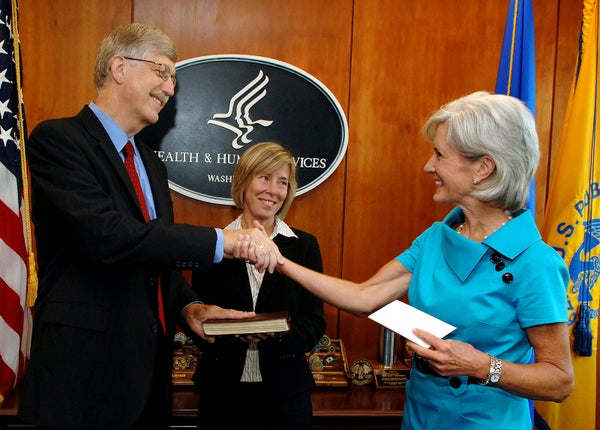
Franics Collins with then-Health and Human Services Secretary Kathleen Sebelius after swearing-in ceremony.

Join Our Community of Science Lovers!

Two leading candidates to serve as director of the National Institutes of Health in the next administration met with President-elect Donald Trump on Wednesday.

The president-elect met at Trump Tower with Dr. Francis Collins, the current NIH director, and Congressman Andy Harris of Maryland, who has expressed an interest in serving in the administration.

Collins, who has led the agency for eight years under President Barack Obama, previously told STAT he would be willing to stay on as director if asked by Trump. Newt Gingrich, the former House speaker who has advised Trump over the last year, also told STAT that Collins was under serious consideration.


On supporting science journalism

If you're enjoying this article, consider supporting our award-winning journalism by subscribing. By purchasing a subscription you are helping to ensure the future of impactful stories about the discoveries and ideas shaping our world today.


Collins has been endorsed by several leading congressional Republicans, but some researchers outside Washington have urged Trump
to consider another candidate.

An obstetric anesthesiologist, Harris is the only member of Congress to have conducted NIH-funded research. He has advocated for lowering the average age of NIH grant recipients and said he would like to see more “high-risk, high-reward” research conducted by the agency.

Peter Thiel, the Silicon Valley mogul, is said to be wielding influence on appointments to science and technology positions in the Trump administration. He also met with the president-elect on Wednesday. It is not known, however, whom he favors for NIH.

Republished with permission from STAT. This article originally appeared on January 11, 2017

STAT delivers fast, deep, and tough-minded journalism. We take you inside science labs and hospitals, biotech boardrooms, and political backrooms. We dissect crucial discoveries. We examine controversies and puncture hype. We hold individuals and institutions accountable. We introduce you to the power brokers and personalities who are driving a revolution in human health. These are the stories that matter to us all.

More by STAT

Subscribe to Support Independent Journalism

Great science journalism requires human expertise, time, effort and creativity. And it costs money. That’s why I and the journalists here at Scientific American hope you’ll join our community.

When you subscribe, you are supporting staff and freelance journalists who are passionate about telling science stories that are true, important and compelling. Our editors and reporters are often experts in their fields, which means they understand the nuances of big discoveries and can untangle the breakthroughs from the hype. With a subscription, you are also supporting rigorous fact-checking to ensure the words we publish are precise and accurate. And you’re supporting original illustrations, graphics and photos that bring you closer to an advanced laboratory, an ice sheet in Antarctica or a space mission in orbit. You’re helping us craft other types of high-quality journalism as well: Our newsletters are carefully written, edited and curated by staffers you have or will come to know and love. Our Science Quickly podcast is based on original reporting, collaboration with editors and scientists and exacting production.

Subscriptions keep this engine running so we can continue to deliver thoughtful, rigorous and independent science journalism to you. In an era of viral misinformation, this work is crucial. If you value what we do, I hope you’ll consider joining us as a subscriber

Thank you,

Jeanna Bryner, Editor in Chief, Scientific American

Subscribe