
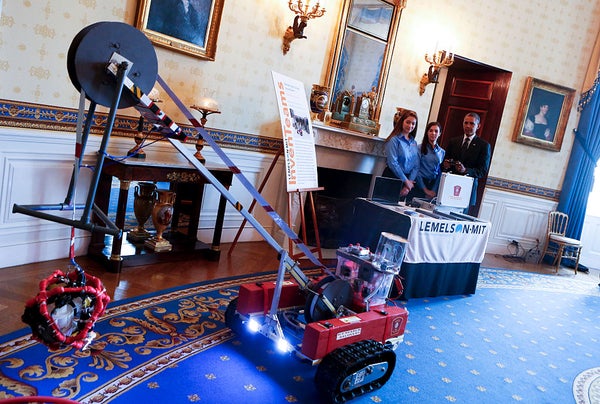
WASHINGTON — The White House still doesn’t have a top science adviser, but it has a science fair in the works.
A White House official said Friday that the science fair, an annual tradition started by former President Barack Obama in 2010, will continue under President Trump. No date has been finalized.
The news, first reported by CBS, comes ahead of a science-centric weekend in Washington. As part of the March for Science, thousands are expected to descend on the National Mall and at satellite marches around the country on Saturday to promote evidence-based policymaking and stress the importance of federally funded basic science research. While organizers have stressed that the event is nonpartisan, it is widely viewed as a rebuke of the current administration, whose policies on climate change and other issues have generated controversy.
On supporting science journalism
If you're enjoying this article, consider supporting our award-winning journalism by subscribing. By purchasing a subscription you are helping to ensure the future of impactful stories about the discoveries and ideas shaping our world today.
Obama’s final science fair in 2016 featured exhibits including a portable diagnostic test for Ebola, an ocean energy harvester, and a robot designed to clean up the New York City subway.
Ivanka Trump, the president’s daughter and one of his key advisers, has advocated alongside Education Secretary Betsy DeVos for increased youth engagement in STEM fields.
But other signs about Trump’s commitment to science have been less comforting for the scientific community. His 2018 budget blueprint included a $5.8 billion cut from budget for the National Institutes of Health, and even congressional Republicans balked at his desire to cut an additional $1.2 billion from the still-unresolved 2017 budget.
Beyond funding, science advocates have expressed concern that the administration has not yet appointed a director of the White House Office of Science and Technology Policy. Obama announced the appointment of his top science adviser, traditionally the head of that office, in December 2008, before his inauguration. The president’s lone science and technology hire, according to the New York Times, is a former adviser to Silicon Valley tech mogul Peter Thiel who has played little role in presidential briefings.
One rumored candidate, Princeton physicist William Happer, has argued that higher atmospheric carbon levels would lead to higher farming productivity and provide a net societal benefit. Trump’s meeting with prominent vaccine skeptic Robert F. Kennedy Jr. has also generated within the scientific community.
Republished with permission from STAT. This article originally appeared on April 21, 2017