
Nuclear power will be a big part of the United States’ space exploration efforts going forward, a new policy document affirms.
President Donald Trump on Wednesday (Dec. 16) issued Space Policy Directive-6 (SPD-6), which lays out a national strategy for the responsible and effective use of space nuclear power and propulsion (SNPP) systems.
“Space nuclear power and propulsion is a fundamentally enabling technology for American deep-space missions to Mars and beyond,” Scott Pace, deputy assistant to the president and executive secretary of the National Space Council, said in an emailed statement Wednesday. “The United States intends to remain the leader among spacefaring nations, applying nuclear power technology safely, securely and sustainably in space.”
On supporting science journalism
If you're enjoying this article, consider supporting our award-winning journalism by subscribing. By purchasing a subscription you are helping to ensure the future of impactful stories about the discoveries and ideas shaping our world today.
Nuclear systems have been important parts of the nation’s exploration portfolio for decades. For example, many of NASA’s highest-profile robotic explorers—including the Voyager 1 and Voyager 2 interstellar probes, New Horizons Pluto spacecraft and Curiosity Mars rover—have derived their power from radioisotope thermoelectric generators (RTGs), which convert to electricity the heat generated by the radioactive decay of plutonium-238.
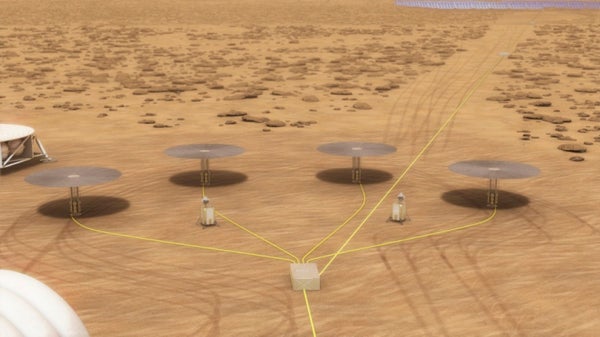
More extensive use of SNPP systems could help that portfolio expand considerably in the near future. For instance, NASA and the U.S. Department of Energy are working together on a fission-reactor project called Kilopower, which could provide juice for crewed outposts on the moon and Mars.
And NASA Administrator Jim Bridenstine has hailed nuclear thermal propulsion, which would harness the heat thrown off by fission reactions to accelerate propellants to incredible speeds, as a potential game-changer for the agency’s deep-space exploration efforts.
SPD-6 firms up and formalizes that commitment to SNPP systems. For example, the document, which you can read here, states that the U.S. should develop, by the mid-2020s, fuel production and processing capabilities sufficient to support a variety of nuclear space systems, from RTGs to nuclear thermal and nuclear electric propulsion.
Another goal laid out by SPD-6 is the demonstration of a “fission power system on the surface of the moon that is scalable to a power range of 40 kilowatt-electric (kWe) and higher to support a sustained lunar presence and exploration of Mars.” This should happen by the mid- to late 2020s if possible, the document states.
SPD-6 is the sixth space policy directive signed by President Trump, as its name suggests. SPD-1 officially instructed NASA to return astronauts to the moon to help prepare for crewed Mars missions; SPD-2 eased regulations on the private spaceflight industry; SPD-3 aimed to help with space-traffic management; SPD-4 directed the Department of Defense to establish the U.S. Space Force; and SPD-5 laid out a cybersecurity policy for U.S. space systems.
As that list indicates, President Trump has been quite active in the space-policy domain. He also resurrected the National Space Council, which had been dormant since the early 1990s. And just last week, he issued a new national space policy, which aims to bolster national security and American leadership in space, among other goals.
Copyright 2020 Space.com, a Future company. All rights reserved. This material may not be published, broadcast, rewritten or redistributed.