
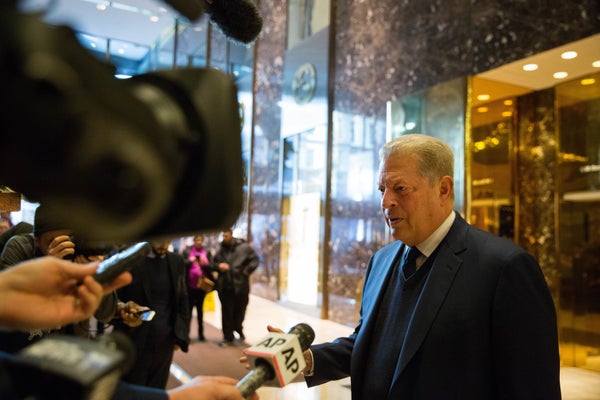
President-elect Donald Trump’s meeting with Al Gore yesterday could soften his image on climate change a week after he claimed to have an open mind about man-made warming, according to some observers.
The discussion came just 27 days after Gore, the former vice president, told voters that electing Trump would be devastating for the planet. Yet Gore emerged yesterday to say the meeting was “extremely interesting.”
It’s unclear if their conversation was impromptu; Gore was in Trump Tower to discuss climate issues with Ivanka Trump, the next president’s daughter, who is reportedly interested in the topic. A Trump spokesman said before Gore’s arrival that Trump would not be meeting with the former vice president.
On supporting science journalism
If you're enjoying this article, consider supporting our award-winning journalism by subscribing. By purchasing a subscription you are helping to ensure the future of impactful stories about the discoveries and ideas shaping our world today.
Those plans changed, and some are suggesting the encounter could benefit Trump by improving his image on a difficult scientific issue that in the past he’s mocked in conspiratorial tones.
“Just talking to Al Gore provides Trump improved climate credibility for some non-expert audiences,” said Paul Bledsoe, a former climate aide in the Clinton White House.
The “political atmospherics” of the meeting might polish Trump’s optics, but Bledsoe is skeptical about its influence on public policy, which is being overseen in some cases by transition officials who question the scientific findings on global warming.
“So far, the signs are not good,” Bledsoe said.
Just before the election, rumors briefly swirled that Gore might advise Democratic candidate Hillary Clinton if she were president. That happened after the two appeared together in Miami for a speech on climate change in October. Both of them lambasted Trump and said that his policies, rooted in skepticism, would cause a disastrous backslide in trying to stem rising temperatures. Gore said Trump would take the world “toward a climate catastrophe.”
Then, on the eve of the election, Gore campaigned on behalf of Clinton for the second and last time.
“This is a climate election,” Gore said in Boulder, Colo. “You could say actually this election means the world, because in a real sense, it does.”
Yesterday, Gore told reporters in Trump Tower that he had a long discussion with the next president. He didn’t provide any clues about the substance of the talk or if he urged Trump to reconsider the role that humans have in raising global temperatures.
“I had a lengthy and very productive session with the president-elect,” Gore said. “It was a sincere search for areas of common ground. ... I found it an extremely interesting conversation, and to be continued, and I’m just going to leave it at that.”
Other observers are more confident in Ivanka Trump as a climate messenger than in Gore.
Chelsea Henderson, who advised former Sen. John Warner (R-Va.) on climate issues, aspires to convene a group of Republican women to help sway Ivanka about the benefits of reducing greenhouse gases. She hopes to meet with the first daughter.
“She’s the right ambassador,” said Henderson, noting that Ivanka is a millennial mother.
Others also see the first daughter as potentially a valuable climate whisperer.
At an event by The Christian Science Monitor that occurred before news of the Gore meeting yesterday, Bipartisan Policy Center President Jason Grumet said the biggest surprise over the next four years would be if Trump deferred to his daughter on the topic of climate.
The audience laughed.
Grumet explained that Trump is “basically unencumbered by any political debt.”
“He’s unencumbered by not a lot of policy, and he is unencumbered by the sense that what happens Tuesday actually has to control what happens Thursday,” Grumet said. “This is incredible power.”
As long as the Trump administration makes efforts to protect coal and manufacturing jobs and fight the Obama regulatory regime, Ivanka could “actually propose a rather forwarding-leaning climate policy,” Grumet said.
Reporter Emily Holden contributed.
Reprinted from ClimateWire with permission from E&E News. E&E provides daily coverage of essential energy and environmental news atwww.eenews.net.