
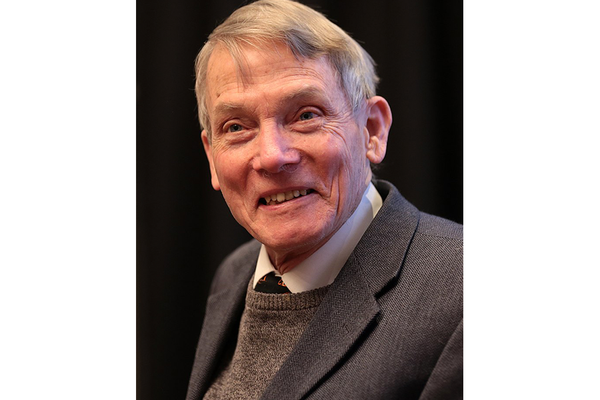

William Happer, a physics professor and vocal critic of mainstream climate science, has joined the White House as a top adviser.
Happer, 79, told E&E News in email that he began serving yesterday on the National Security Council as the senior director for emerging technologies. NSC officials confirmed Happer’s new role but declined to provide further detail about the appointment, which CNN first reported.
When asked about his new NSC role, Happer said he would do his best to ensure that federal policy decisions “are based on sound science and technology.”
On supporting science journalism
If you're enjoying this article, consider supporting our award-winning journalism by subscribing. By purchasing a subscription you are helping to ensure the future of impactful stories about the discoveries and ideas shaping our world today.
An emeritus physics professor at Princeton University and a former Energy Department official under the George H.W. Bush administration in the 1990s, Happer is well-known for his public criticism of mainstream climate modeling and his ties to the Trump administration.
Happer last year was considered a leading candidate to head the White House Office of Science and Technology Policy and met with the president in Trump Tower before the inauguration. Happer told E&E News in an interview earlier this year that Trump asked him about Russia during that meeting (Climatewire, Jan. 25).
Happer told The Scientist that the significance of climate change has been “tremendously exaggerated” and has “become sort of a cult movement in the last five or 10 years.” Happer also said President Trump, who has referred to climate change as a Chinese hoax, agreed with his assessment.
More recently, Happer has appeared in internal emails obtained under the Freedom of Information Act advising the Trump administration’s efforts to challenge mainstream climate science, including assembling and vetting proposed participants for former EPA Administrator Scott Pruitt’s “red-team, blue-team” debate (Climatewire, May 10).
Happer, who is not a climate scientist by training, is known in physics for his development in the 1980s of the sodium guide star that was initially used for missile defense technology and has now gained broader application in astronomy. According to his Princeton bio, he’s credited as one of the pioneers in the field of optically polarized atoms.
But his criticism of climate science stands out.
Happer has accused both NOAA and NASA of manipulating temperature records and claimed that higher concentrations of carbon dioxide in the atmosphere would accentuate plant life, citing satellite data showing a greening of the planet.
“The public in general doesn’t realize that from the point of view of geological history, we are in a CO2 famine,” he told E&E News during the interview in January.
Many researchers say other impacts of climate change, such as rising temperatures and changing rainfall patterns, have a negative impact on plant life and that higher CO2 levels may not be a boon to all plants, even in the short term.
Happer told E&E News in January that he supported Trump’s decision to pull the United States out of the Paris climate accord but said he wished the president had focused on how the agreement “did not make scientific sense.” Trump had cast the pact as detrimental to the U.S. economy.
“There is no problem from CO2,” Happer said. “The world has lots and lots of problems, but increasing CO2 is not one of the problems. So [the accord] dignifies it by getting all these yahoos who don’t know a damn thing about climate saying, ’This is a problem, and we’re going to solve it.’ All this virtue signaling. You can read about it in the Bible: Pharisees and hypocrites and phonies.”
Reporter Robin Bravender contributed.
Reprinted from Climatewire with permission from E&E News. E&E provides daily coverage of essential energy and environmental news at www.eenews.net.