
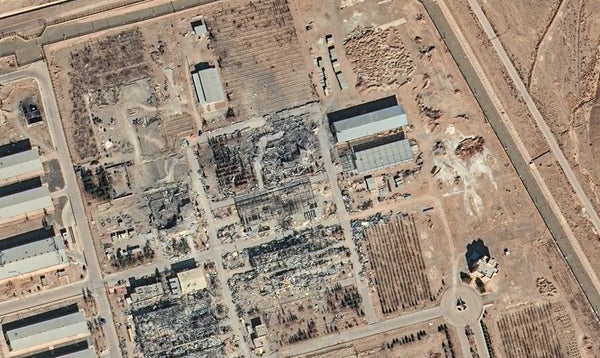
Among the many points of disagreement between Iran and the U.S. during the current conflict is the fate of Tehran’s highly enriched uranium (HEU): some 972 pounds of up to 60 percent enriched uranium, all or most of which may be buried under rubble created by U.S. bombing runs in June 2025.
On April 16 U.S. president Donald Trump said that Iran had offered to give up what he called the nation’s “nuclear dust,” a claim that remains unconfirmed by Iranian officials. But what would such an operation look like?
First, it would not involve dust.
On supporting science journalism
If you're enjoying this article, consider supporting our award-winning journalism by subscribing. By purchasing a subscription you are helping to ensure the future of impactful stories about the discoveries and ideas shaping our world today.
In nature, uranium occurs as a mix of three radioactive isotopes: uranium 238, uranium 235 and uranium 234, which are differentiated by the number of neutrons in their nuclei. This mix undergoes slow radioactive decay but is not prone to fission, the atom-splitting chain reaction that powers nuclear reactors and nuclear weapons. Enrichment involves concentrating the uranium 235. The process typically starts with the conversion of uranium oxide into stable gaseous uranium hexafluoride, or UF6, followed by a centrifuge technique that separates the three isotopes by mass. Enrichment up to about 5 percent makes uranium fissile enough for nuclear power, while enrichment of at least 20 percent is the absolute minimum needed for weaponry.
READ MORE: Iran was nowhere close to a nuclear bomb, experts say
Though UF6 gas can be converted back into a solid after enrichment, according to the International Atomic Energy Agency (IAEA), as of June 2025, Iran held its enriched uranium stockpile as gaseous UF6. Thus, the stockpile is likely stored in cylinders that are not unlike large scuba tanks. Though it’s not certain, these tanks may have been packed into enormous blue containers called “overpacks” and sealed in tunnels deep under Iran’s nuclear site in Isfahan, according to an analysis of satellite imagery by the French newspaper Le Monde. If so, the containers may be intact deep underground despite the bombing of the site.
That would make recovery relatively straightforward, if labor-intensive—were Iran, in fact, cooperative. If no cooperation is forthcoming, on the other hand, a military operation would be “unlike any mission the U.S. military has tried before,” says Scott Roecker, vice president of the Nuclear Materials Security Program at the nonprofit Nuclear Threat Initiative.
Either way, getting to the uranium will require heavy earth-moving equipment, says Cheryl Rofer, a retired Los Alamos National Laboratory chemist, who participated in nuclear material cleanups in Estonia and Kazakhstan. If the canisters were indeed stored in overpacks, they are likely safe, because these containers are designed to both shield uranium from damage and keep the canisters far enough apart to avoid criticality, an uncontrolled nuclear chain reaction. UF6 itself does not give off much radiation, but Geiger counters would probably be used to monitor radiation levels to ensure that workers’ exposure remains low, Rofer says.
Inside the canisters, gaseous UF6 can be compressed enough that the UF6 solidifies, she says. As long as those containers remain intact, they can be handled by experienced technicians without much risk. If they leak or get punctured, however, the compressed UF6 will rapidly expand into a gas, react with humidity in the air and form uranyl fluoride and hydrogen fluoride, the latter of which can further react with water to make corrosive hydrofluoric acid. These compounds can be immediately fatal if inhaled.
A criticality accident—which would lead to local radioactive contamination—could occur if a large enough mass of UF6 were to be placed close together. Clean-up operations involve experts who calculate the risk of a criticality accident based on the characteristics of the material being moved, Rofer says. Those assessments would then inform the packing used to transport the uranium.
If Iran and the U.S. were to work together, an international team would likely weigh and analyze the uranium with x-rays to confirm the amount and its enrichment, Roecker says. It could then be repacked in overpacks, removed from the site by plane, train or ship and diluted into fuel for nuclear power plants. Without Iran’s cooperation, on the other hand, the U.S. military would have to set up a perimeter, fly in heavy earth-moving equipment and hold on for weeks during the digging and packing process. Without the cooperation of Iranian nuclear scientists, the U.S. would also be dealing with many more uncertainties about the material and the way that it was packed. “If you have unfriendly people around you that are shooting at you, that’s going to make it a whole lot harder,” Rofer says.
The Department of Energy has mobile labs that could be used to analyze and pack the uranium even if Iran’s facilities were destroyed, Roecker says. But it’s unlikely that the HEU is leaving Iran without a diplomatic agreement, he adds. “I’ve never seen that in my experience,” Roecker says, “that you’re able to remove HEU in an uncooperative scenario.”