
The Trump administration has significant power to undermine the workings of the Affordable Care Act. The bigger question is how much of that power it will use.
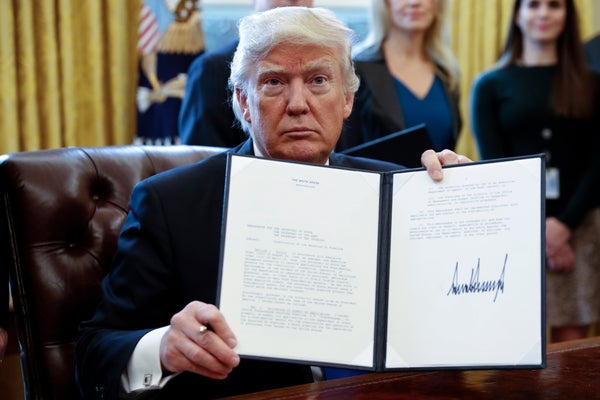
President Donald Trump’s executive order on Inauguration Day urging federal officials to “take all actions consistent with law to minimize the unwarranted economic and regulatory burdens” of the federal health law did not provide administration officials with any new powers to unravel parts of the law.
“They had all this authority before,” said Len Nichols, a health policy professor at George Mason University in Virginia who supports the health law. Trump, he said, “is signaling ‘I care’” about this issue.
On supporting science journalism
If you're enjoying this article, consider supporting our award-winning journalism by subscribing. By purchasing a subscription you are helping to ensure the future of impactful stories about the discoveries and ideas shaping our world today.
In the short term, efforts will be minimal, said Joe Antos of the conservative American Enterprise Institute, because the White House is still getting its personnel on board. There are no high-level political appointees yet installed at the Department of Health and Human Services, Labor and Treasury, which have primary authority over the law.
“They need their appointees,” said Antos. Until more Trump personnel actually start work, he added, “I don’t think they’re going to be able to do much.” The nominees for secretaries of HHS, Labor and Treasury are encountering various degrees of turbulence in their Senate confirmation process.
But even when the new personnel do take office, it remains unclear exactly how far the new administration will go. That’s because while they can make the law stop working, it will take Congress to actually put in place something new.
“If they start down that road” of unraveling the law, said Nichols, “then the insurers will pull out as soon as possible. And 2018 will not be pretty.” That’s a reference to the fact that plans offering coverage in the individual market are concerned that changes would make it easier for healthy people to exit the market, leaving only sicker and more expensive people behind and no way to spread costs.
Yet both Trump and Republican leaders in Congress have vowed not to strip away anyone’s insurance and to provide a “stable transition” to a new system. Trump told The Washington Post earlier in the month his goal was “insurance for everybody.”
And Antos said that many of the administration’s options might be more difficult than they first appear.
For example, he pointed to one item that has been widely speculated as a possible change the administration is considering: cutting back the specific requirements for benefits that have to be included in various health plans.
Although such alterations are theoretically subject to rewrite through regulations, “it’s the state insurance commissioners that approve that,” he said. “The states all changed their regulations in order to conform with the federal rules.”
Indeed, according to the National Conference of State Legislatures, 46 states enacted more than 175 separate laws between 2011 and 2013 to bring their rules into accord with the federal health law.
Those states “might have to repeal or amend their laws if the ACA were repealed,” said Timothy Jost, an emeritus law professor at Virginia’s Washington and Lee University who has studied the health law extensively. “For example, states that adopted the insurance reforms into law might find their markets nonviable without the federal subsidies and mandates.”
In addition, any changes made by the Trump administration would have to take care to stay within the confines of federal requirements, including allowing for public notice and comment, said Antos, which gets particularly complicated with health care because it crosses so many boundaries.
“There has to be coordination between HHS and Treasury and maybe Labor, and it has to be legal,” he said. “So understanding what you can and cannot do is going to be very difficult.”
To be clear, there are a couple of actions the administration could take fairly easily that would have a major impact. The largest would likely come from dropping the appeal of a lawsuit that would immediately end cost-sharing help for up to 6 million people with incomes under 250 percent of the poverty line.
That would almost certainly send the insurance market for individuals into chaos, bothbackers and opponents of the health law agree, and would interfere with GOP promises to try to ensure stability in the market until they can come up with a replacement.
A second, more strategic change would be to eliminate the special rule that ensures that members of Congress and their staffs can still get employer contributions for their insurance, even though the law requires them to purchase that coverage through the health law’s insurance exchanges.
“If Trump undoes that, then members and staff take a pay cut of up to $12,000 immediately,” because they would have to make up the premium costs on their own, said Michael Cannon of the libertarian Cato Institute, an opponent of the health law. “That will motivate members of both parties to behave differently” in the speed with which they might come up with a health law replacement.
But even Cannon, who would like to see the law eliminated as soon as possible, concedes that “the politics of those two things would be dicey.”
This story was originally published by Kaiser Health News on January 24, 2016. Read the original story here.