
In January middle school and high school students at more than 200 host sites across the U.S. and parts of Canada competed in the North American Computational Linguistics Open Competition (NACLO), which involves finding and applying language patterns to solve tricky linguistic puzzles.
The more than 250 students who scored above the cutoff were invited to compete in today’s locally hosted invitational round, and eight or 12 eligible winners will go to Bucharest, Romania, for the 23rd annual International Linguistics Olympiad (IOL) in July.
These students represent the future of computational linguistics, a field that uses computers and algorithmic methods to detect and understand patterns in language. Interest in the field has skyrocketed as coders have used linguistic principles to build and improve large language models, which power much of today’s generative artificial intelligence. According to Lori Levin, one of the founders of NACLO and a computational linguist at Carnegie Mellon University, computational linguistics is a two-way street: “You’re either using a computer to do things with human language or communicate or translate or teach a foreign language, or you’re using computational techniques to learn something about human languages.” Her work documenting and preserving endangered languages uses a little bit of both.
On supporting science journalism
If you're enjoying this article, consider supporting our award-winning journalism by subscribing. By purchasing a subscription you are helping to ensure the future of impactful stories about the discoveries and ideas shaping our world today.
Tom McCoy, a former NACLO winner who is currently a competition organizer and computational linguistics researcher at Yale University, works to bridge the gap between how language is handled in large language models and how it’s described in linguistic theory. “This includes trying to understand what’s going on inside AI systems that process language, like ChatGPT, and then also understanding how we can use those AI systems to give us insight into the human mind,” McCoy says.
According to McCoy, who also writes crossword puzzles for the New York Times, writing and solving NACLO problems has a similar feel to what he does as a linguist. “It really is about trying to replicate that problem-solving experience that linguists are faced with,” he says. “I owe my career to NACLO.... I would have never learned about the field in time to join it if not for having done that in high school. And I’m definitely not the only one.”
Many NACLO participants end up working on computational linguistics in academia or industry; some others go on to study mathematics, computer science, chemistry or physics. “Regardless of what people end up doing, it is a great way for people to practice their problem-solving skills,” says Cerulean Ozarow, one of the winners of NACLO 2020 and a math teacher at Hunter College High School.
When Levin was asked to found a North American computational linguistics competition in 2006, her response was “I’ll do it, unquestionably.” Shortly after, the late computational linguist Dragomir Radev heard about Levin’s efforts; he called her up and said, “I’m going to be there whether or not you have the space and money for me.” The enthusiasm of NACLO’s co-founders, including Levin and Radev, for sharing computational linguistics with the world has carried through the ethos of the competition, which was first held in 2007 and is run solely through volunteer work. Levin strives to serve “all students—not just the ones who are going to win.” She and other NACLO organizers hope to reach even more students by adding an extra introductory round with more accessible questions.
Levin’s favorite part of running NACLO is “seeing the lights go on” for participants who are inspired to become a linguist themselves or are just having fun with language and learning about new linguistic possibilities. “Generally linguistics isn’t taught in school,” Levin says, “and so when you solve a NACLO puzzle, you suddenly see a way that language can be that maybe you hadn’t thought of.”
Below you can try five puzzles adapted from past NACLO competition problems for yourself and learn more about language—not to mention AI language models.
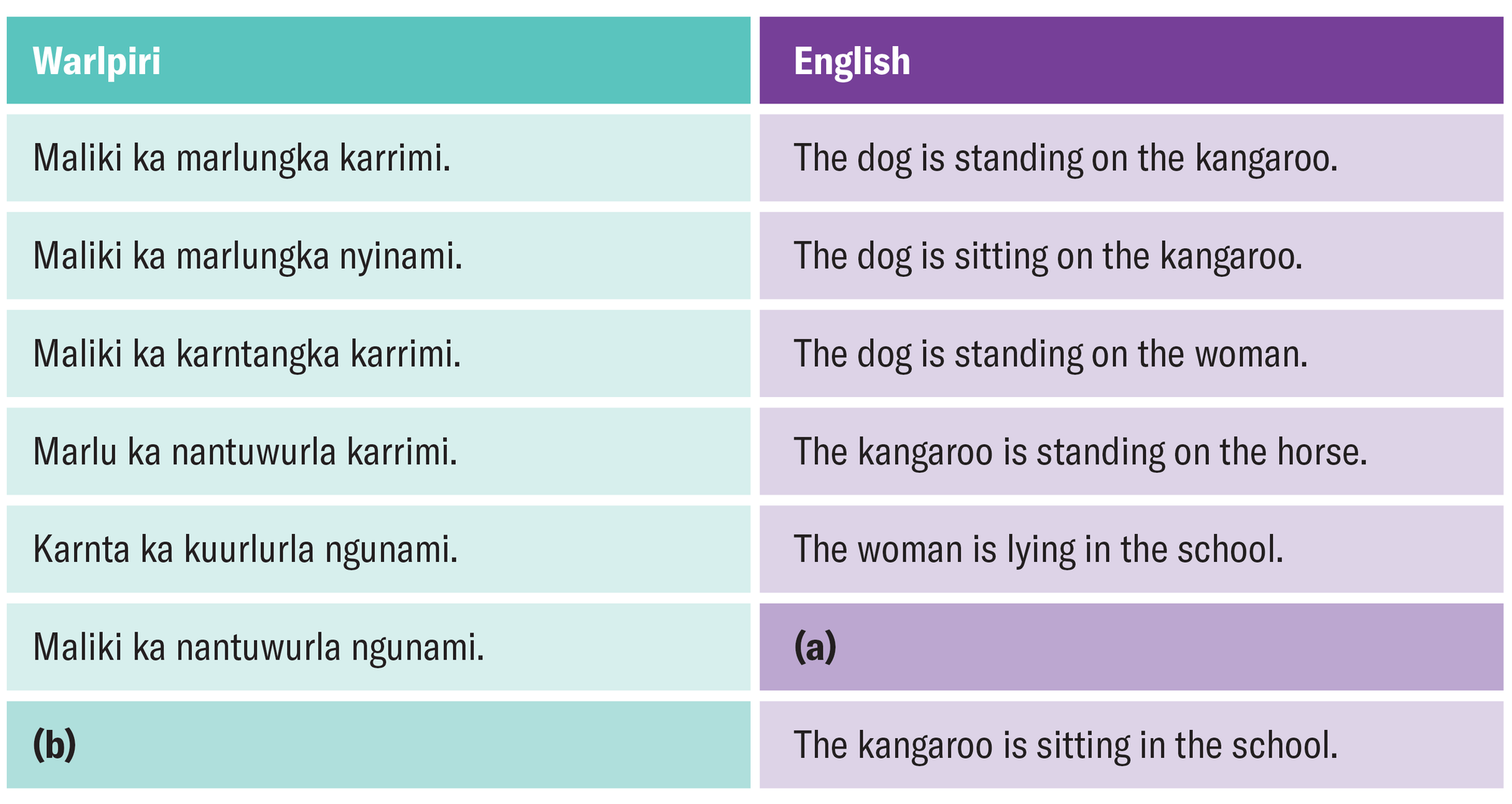
Finding Your Place in Warlpiri
Warlpiri is a language spoken by about 3,000 people in Central Australia. Below are some sentences in Warlpiri, along with English translations. Can you determine what goes in the blank cells?
Game: Set Match
Match each word to a numbered label so that the Venn diagrams are accurate. (For example, a circle labeled “chihuahua” would be totally included in a circle labeled “dog.” A circle labeled “large animal” would intersect one labeled “dog” but not “chihuahua.”)
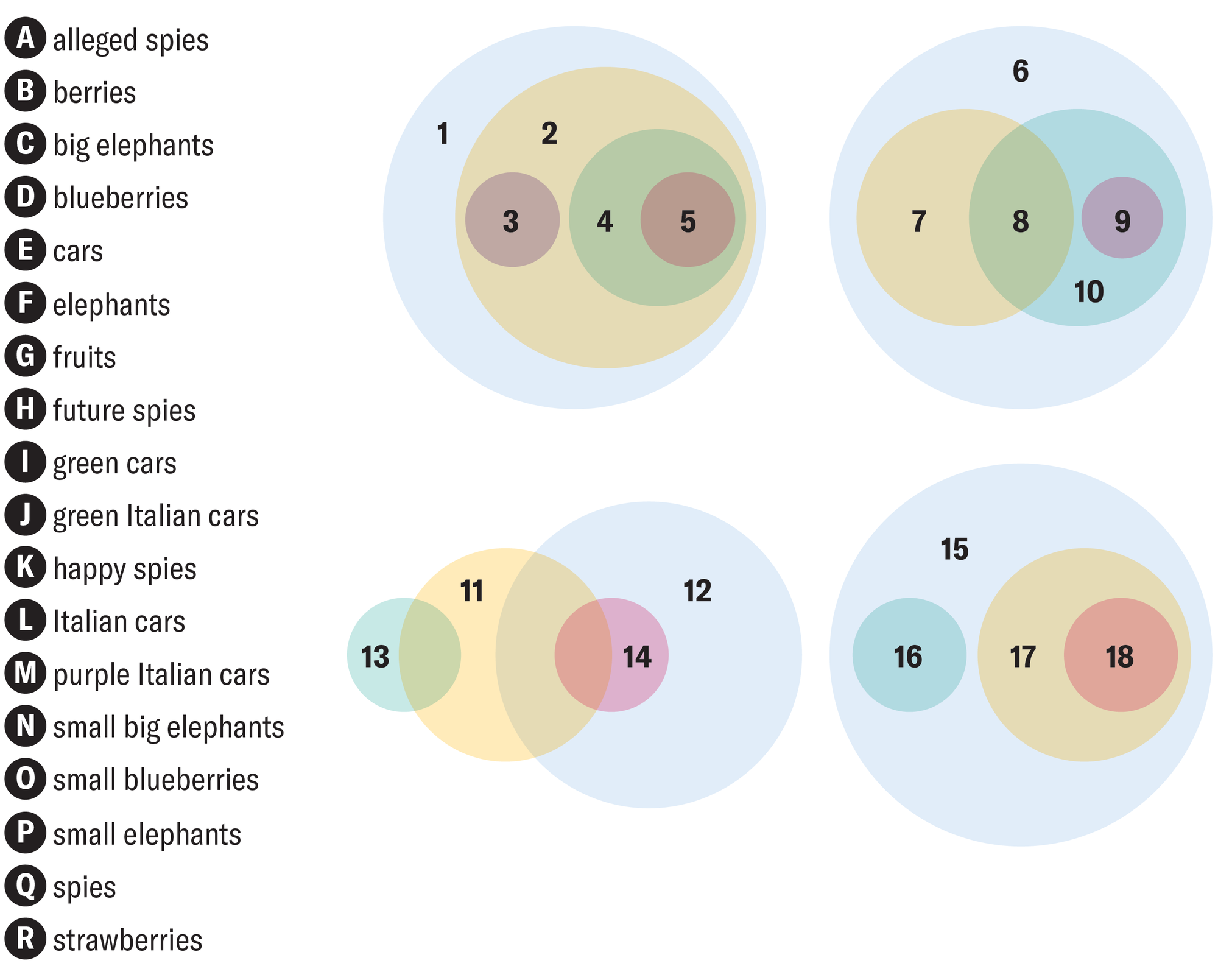
Each number goes with the circle that it touches, except for 8, which goes with the intersection of the 7 and 10 circles.
Alleged spies are people who have been accused of being spies but who may or may not actually be spies.
The phrase small big elephants may be confusing without context. Here’s an example where it can occur: “That’s a big elephant, but compared to other big elephants it’s relatively small; it’s a small big elephant.”
We assume that cars cannot be both green and purple at the same time.
In this problem, we use the informal definition of the word berry, in which strawberries are a type of berry (even though there is a technical definition of berry that excludes strawberries).
We assume that elephants cannot be spies. In real life, this is a dangerous assumption to make.
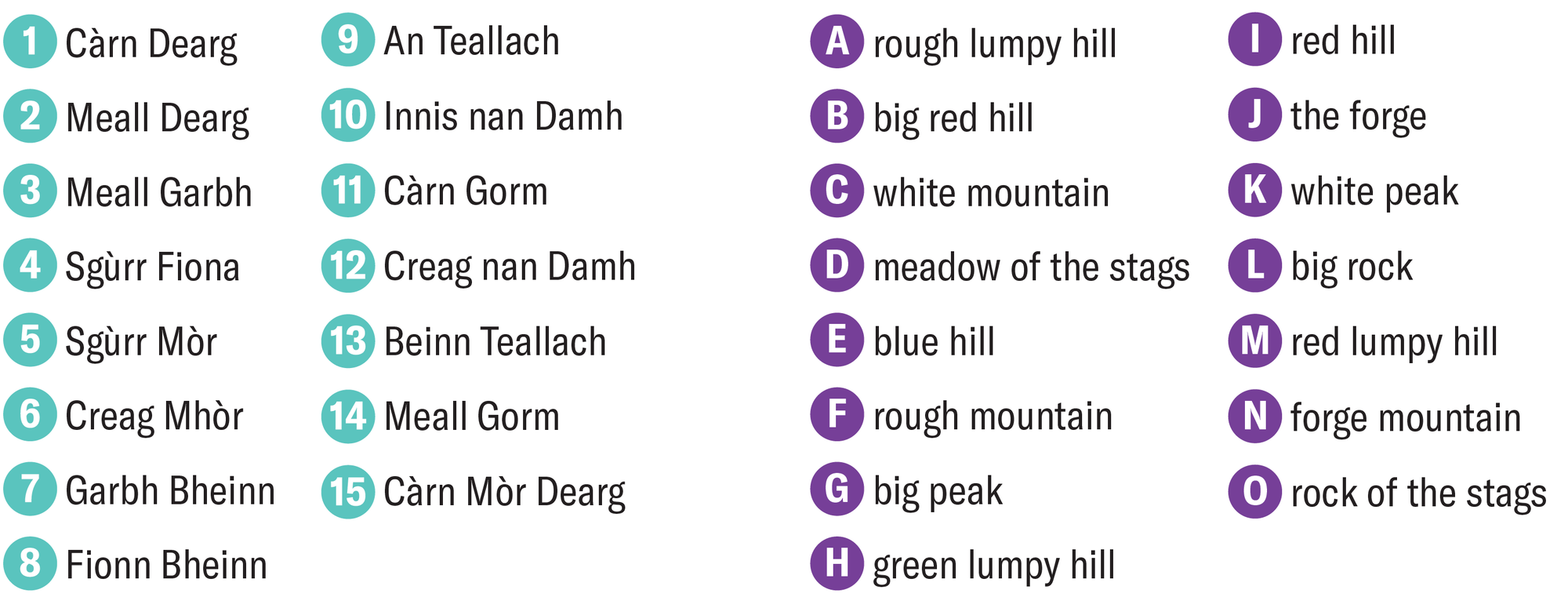
In the Scottish Highlands
Match each Scottish Gaelic phrase with its meaning in English:
Not Quite Right
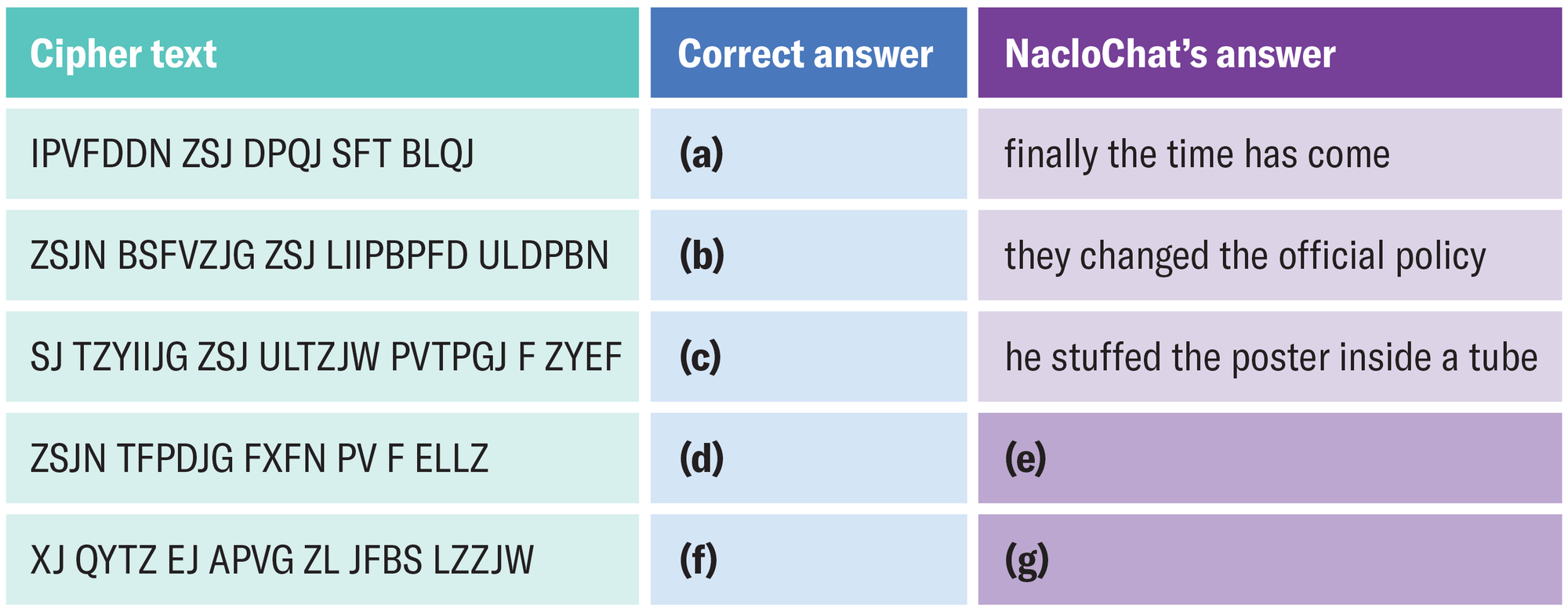
A large language model (LLM) called NacloChat has attempted to decipher a series of phrases. Each letter in the coded phrases consistently represents another letter when decoded. The LLM got one letter wrong in each case. Can you fill out the rest of the chart?
Color Me Confused
Below is a table of words used to describe color in various languages:
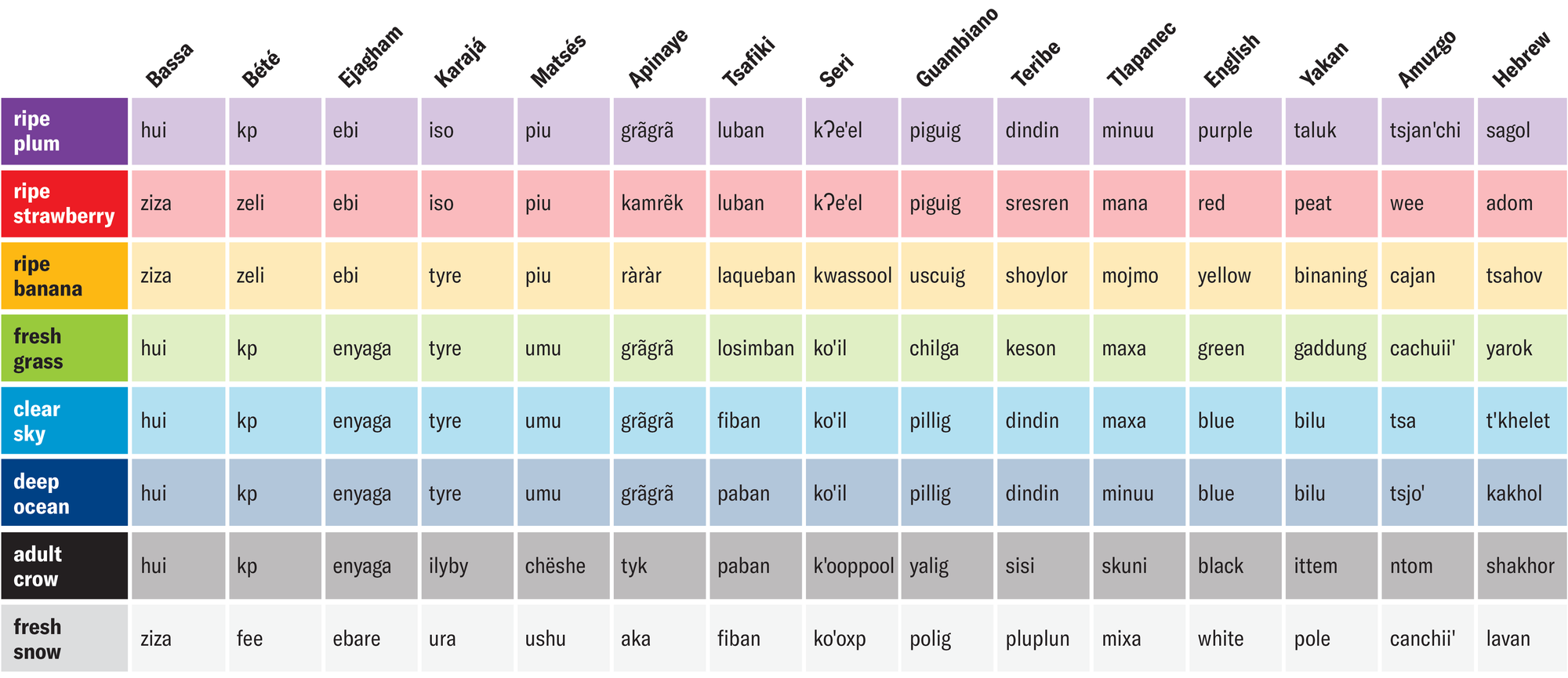
Can you determine which letter corresponds to which row in the below rules about language and color?
Every language has at least two basic color terms that distinguish between (A) and (B).
If it has at least three, it uses different words for each of (A), (B) and (C). If it has only three, the same word is used for both (B) and (D).
If it has at least five, it distinguishes between (B) and (D) and also has a unique word for (E).
If it has at least six, it distinguishes (D) from (F).
A language only has a unique word for (G) if it also has one for (H). If it does not have a unique word for (H), (G) will share a word with at least one of (A), (D) or (F).
These rules are simplified from a set proposed by anthropologist Brent Berlin and linguist Paul Kay in 1969. We now know they are not completely true for all languages, though they do accurately describe most.
If you enjoyed these puzzles, you can find the full versions, along with hundreds more, on the official NACLO website.
Finding Your Place in Warlpiri
a. The dog is lying on the horse.
b. Marlu ka kuurlurla nyinami.
Game: Set Match
1. G, 2. B, 3. R, 4. D, 5. O, 6. E, 7. I, 8. J, 9. M, 10. L, 11. A, 12. Q, 13. H, 14. K, 15. F, 16. P, 17. C, 18. N
In the Scottish Highlands
1. I, 2. M, 3. A, 4. K, 5. G, 6. L, 7. F, 8. C, 9. J, 10. D, 11. E, 12. O, 13. N, 14. H, 15. B
Not Quite Right
a. finally the lime has come
b. they chanted the official policy
c. he stuffed the poster inside a tuba
d. they sailed away in a boot
e. they sailed away in a boat
f. we must be kind to each otter
g. we must be kind to each other
Color Me Confused
A: fresh snow, B: adult crow, C: ripe strawberry, D: fresh grass, E: ripe banana, F: deep ocean, G: clear sky