
By Will Dunham
WASHINGTON, March 16 (Reuters) - For more than half a century, scientists have scratched their heads over the nature of an outlandishly bizarre creature dubbed the Tully Monster that flourished about 307 million years ago in a coastal estuary in what is now northeastern Illinois.
But researchers on Wednesday announced they have finally solved the mystery.
On supporting science journalism
If you're enjoying this article, consider supporting our award-winning journalism by subscribing. By purchasing a subscription you are helping to ensure the future of impactful stories about the discoveries and ideas shaping our world today.
They analyzed numerous fossils of the creature, named Tullimonstrum gregarium, and determined it was not a segmented worm or a free-swimming slug, as once hypothesized, but rather a type of jawless fish called a lamprey.
"I would rank the Tully Monster just about at the top of the scale of weirdness," said paleontologist Victoria McCoy of Britain's University of Leicester, who conducted the study while at Yale University.
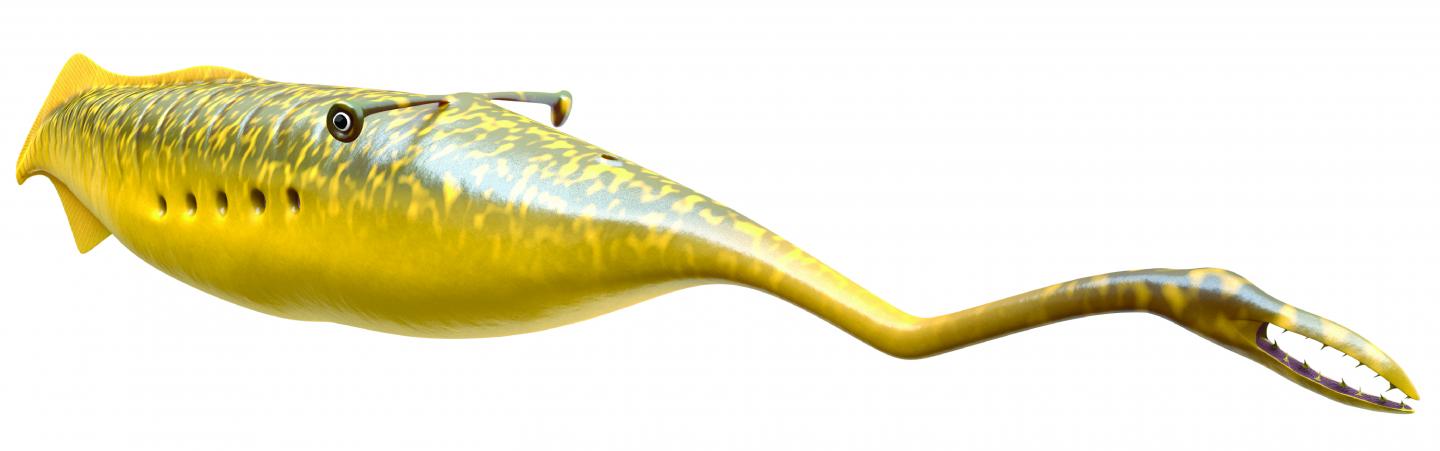
This is a reconstruction illustrating what Tully monster looked like.
Credit: Sean McMahon via EurekAlert
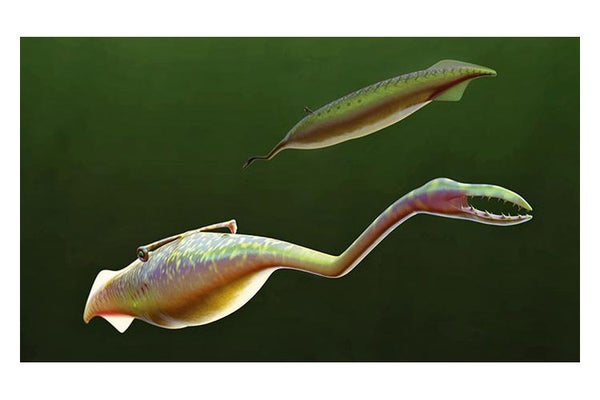
It boasted a torpedo-shaped body, a jointed, trunk-like snout ending in a claw-like structure studded with two rows of conical teeth, and its eyes were set on the ends of a long rigid bar extending sideways from the head. Up to about 14 inches (35 cm) long, it had a vertical tail fin and a long, narrow dorsal fin.
A sophisticated reassessment of the fossils determined it was a vertebrate, with gills and a stiffened rod, or notochord, that functioned as a rudimentary spinal cord and supported its body. The notochord previously had been identified as the gut.
"I've always loved detective work, and in paleontology it doesn't get much better than this," said paleontologist James Lamsdell of the American Museum of Natural History in New York. "Our re-study of the specimens has shown that it is a very strange lamprey, a group of eel-like vertebrates that live in rivers and seas today."
Tullimonstrum shared its shallow marine environment with fish including sharks as well as jellyfish, shrimp, amphibians and horseshoe crabs.
"It fed by grasping things with the proboscis (snout) and scraping bits off with its tongue. We don't know what it ate or if it was a predator or scavenger," McCoy said.

This is a holotype fossil specimen of the Tully monster.
Credit: Paul Mayer, The Field Museum via EurekAlert
It is called the Tully Monster in honor of amateur fossil-hunter Francis Tully, who first found it in Illinois coal-mining pits in 1958 and brought it to experts at the Field Museum in Chicago.
"This puzzle has been gnawing at paleontologists," said Field Museum paleontologist Scott Lidgard, whose museum holds 1,800 specimens of Tullimonstrum, the official state fossil of Illinois. "I was blown away when the results started coming in."
The research was published in the journal Nature. (Reporting by Will Dunham; Editing by Sandra Maler)