
Scientists are shocked and angry at the UK government’s sudden confirmation on January 26 that it wants to pull out of the European Union’s nuclear agency Euratom, as part of its arrangements for Brexit.
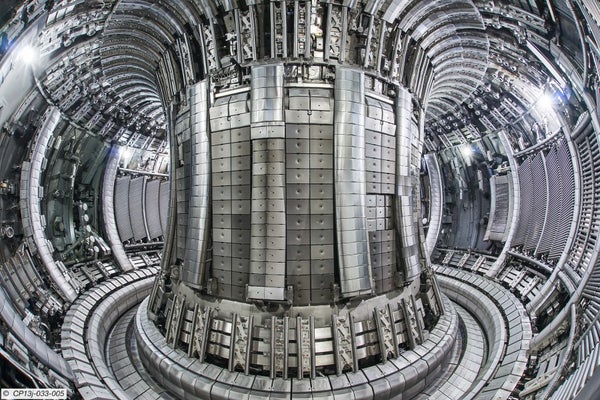
Depending upon whether and how the UK negotiates a way back in to the organization, the move could endanger British participation in the world’s largest fusion experiment, the International Thermonuclear Experimental Reactor (ITER) in Cadarache, France. It could also curtail operations at the Joint European Torus (JET), a nuclear-fusion facility based in Culham, UK. The facility is a half-sized version of ITER and acts as a test-bed for it; it currently receives around €56 million ($60 million) annually from Euratom.
"It is simply bonkers to leave Euratom," says Steven Cowley, a nuclear fusion researcher who until last year was director of the Culham Centre for Fusion Energy, which hosts JET.
On supporting science journalism
If you're enjoying this article, consider supporting our award-winning journalism by subscribing. By purchasing a subscription you are helping to ensure the future of impactful stories about the discoveries and ideas shaping our world today.
“This has happened without discussion or analysis. It's left us in shock. Not the behaviour of a transparent government,” tweeted Scientists4EU, a lobby group originally set up to campaign against Brexit.
The Culham Centre's current director, Ian Chapman, has told Nature that — after meeting with government officials — he is sure that the UK has no intention of drawing back from nuclear research and development or civil nuclear programmes. “There’s no indication that this means we’re stopping our nuclear program, far from it," says Chapman, who is also chief executive of the UK Atomic Energy Agency.
The UK will have to change how it participates in these programs, however. "There’s still a commitment from the government to think about how we can put in place arrangements to continue running JET, and to continue participating in the ITER program,” Chapman says.
“The nuclear industry remains of key strategic importance to the UK and our withdrawal from the Euratom Treaty in no way diminishes our nuclear ambitions”, a spokesperson from the UK’s Department for Business, Energy and Industrial Strategy says.
Quiet announcement
Euratom predates the formation of the EU. But the two are legally entangled, and experts had predicted that Brexit, the UK’s departure from the EU, would likely mean the UK also leaving Euratom.
For months, it was unclear whether the UK government wanted to leave Euratom, or how a transition away from the agency would occur. (Nature's questions on the issue went unanswered).
But on 26 January, confirmation that it intended to leave Euratom appeared in notes appended to a short Parliamentary bill. That legislation is meant to allow the UK’s Prime Minister to trigger ‘Article 50’, the formal notification of the UK’s withdrawal from the EU.
Alexandrine Kántor, a senior electrical designer at the Culham Centre for Fusion Energy, stated on Twitter that it was the first she’d heard of it. “Always nice to know you might lose your job via the newspapers, cause the gov' didn't think it necessary to tell your CEO,” she wrote.
Hazy consequences
The consequences of pulling out of Euratom are uncertain, as are many implications of Brexit. Besides the uncertainty facing JET and ITER, some reports suggest it could bring higher costs for regulating existing nuclear facilities and delay the building of new power stations while the UK makes new arrangements.
The UK could become a Euratom “third country”, like the United States — which has a cooperation agreement that allows it to participate in some programs. That status would not automatically make the UK a member of ITER, however. And although Euratom is technically able to pay third countries, it would be unlikely to continue funding JET. The UK government has not said whether it would then pick up the bill for the facility.
Alternatively, the UK could become an “associate country” of Euratom — like Switzerland, which gained this status in 2014 and participates in ITER. Under this arrangement, Euratom would be more likely to continue funding JET.
JET’s contract runs out in 2018 and negotiations over an extension to 2020 are ongoing. Now, if the facility's funding is cut in 2019, when the UK is currently scheduled to leave the EU, that could delay or prevent a fusion experiment using the heavy hydrogen isotopes deuterium and tritium. This trial is intended as a dress-rehearsal, to indicate whether ITER’s magnetic-confinement technology will perform as hoped when it runs with this mix, some time in the 2030s.
The UK’s Nuclear Industry Association (NIA) has called on the UK government to agree to transitional arrangements, which would see the UK remain part of Euratom until it had time to renegotiate international agreements which are currently all managed through the organisation.
The complex process of leaving Euratom ought to be done in a careful and deliberate manner, Chapman says, even if it takes longer than the two years prescribed for Brexit in Article 50. But the UK’s ‘Brexit ministry’ — the Department for Exiting the European Union — says that the 2-year time-limit applies to leaving Euratom as well.
This article is reproduced with permission and was first published on January 27, 2017.