
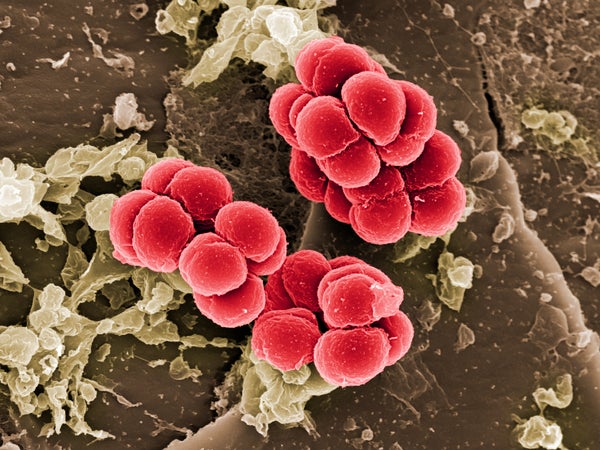
Top United Nations leaders put the threat of growing antibiotic resistance in stark terms Wednesday at a daylong meeting devoted to the issue. At the gathering in New York City they successfully urged governments to sign onto a political declaration to combat antibiotic resistance in their own nations and around the world. “We are losing our ability to protect both people and animals from life-threatening infections,” warned U.N. Secretary General Ban Ki-moon. “It’s a very present reality.”
“The situation is bad and getting worse,” echoed Margaret Chan, director of the World Health Organization. “Over the past half century only two new classes of antibiotics reached the market with few replacement products in the pipeline. The world is headed to a post-antibiotic era in which infections, especially those caused by gram-negative bacteria, will kill.” The situation is complex, Chan said, and a central problem is a lack of good financial impetus for pharmaceutical companies to create new antibiotics—largely because of poor returns on investment. That, she said, must change with the creation of better incentives.
U.N. officials insisted that countries should signal their commitment to the issue by signing the political declaration, and must then convert that plan into immediate action. Representatives from Guyana, Thailand, Argentina, Zimbabwe, Belgium and other nations spoke about the problem and its importance to their governments. Drug-resistant infections kill an estimated 700,000 people each year according to a recent report on this issue commissioned by the British government. Failure to act may push that number to 10 million by 2050, the report said.
On supporting science journalism
If you're enjoying this article, consider supporting our award-winning journalism by subscribing. By purchasing a subscription you are helping to ensure the future of impactful stories about the discoveries and ideas shaping our world today.
The political declaration was approved at the meeting early Wednesday and will be formally adopted by the plenary of the U.N. General Assembly at a later date. It calls for the creation of an interagency coordination group to spearhead future action in this area, and for a new report to be drawn up within two years detailing further recommendations from the group on how to attack the problem. The agreement “doesn’t go as far as I had hoped but it certainly goes further than I had expected, the reason being this is the U.N. It’s not a body that typically deals with health issues,” says Ramanan Laxminarayan, director of the Washington, D.C.–based Center for Disease Dynamics Economics & Policy.
The U.N. declaration calls for action on multiple fronts, including slashing the use of antibiotics to promote growth in farm animals, limiting their use among humans to only when they are truly necessary and ramping up education about these issues. It says better understanding of superbugs’ biology is needed, along with monitoring of the scale of the problem. The declaration states that without action, “there will be fewer options for the protection of people most vulnerable to serious life-threatening infections, especially women giving birth, newborns, patients with certain chronic diseases or those undergoing chemotherapy or surgery.” Additionally, specific actions are needed to help safeguard the current stockpile. Consumers should get available vaccines to prevent sickness, stop asking for antibiotics when they have a cold or the flu (which are caused by viruses and therefore don’t respond to antibiotics) and urge their political leaders to commit to action in combating antibiotic resistance, Chan said.
“The declaration is an important symbol, but it's up to the individual member countries to turn it into concrete action. We see inspiring leadership from the U.K. and the E.U. but here in the U.S. we need a high-level official backed with the necessary funding and political support to tackle the antibiotic resistance crisis,” says Lance Price, a microbiologist and director of the Antibiotic Resistance Action Center at The George Washington University.
Beyond the international commitment there is also the need for financing to convert this type of agreement into action, Ban said. The U.N. declaration suggests countries should look to public-private partnerships to help shore up such efforts. “We all share responsibility for the development of antimicrobial resistance,” said Monique Eloit, director general of the World Organization for Animal Health. Beating this threat back means “we will all share victory,” she added.