
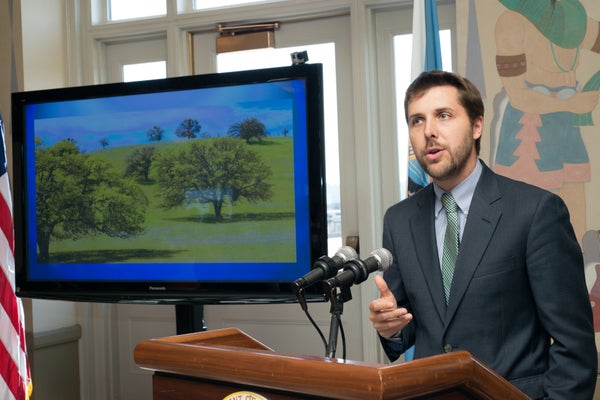
White House senior adviser Brian Deese is in Beijing this week laying the groundwork for President Obama's visit to China next month.
Deese's agenda includes meetings with Executive Vice Premier Zhang Gaoli and Xie Zhenhua, special representative for climate change, according to the White House.
The discussions will center on key international environmental agreements, namely the details of implementing the Paris Agreement to curb global greenhouse gas emissions, as well as developing a market to cut emissions from air travel (see related story). The Obama administration is also hoping to secure a new amendment to the Montreal Protocol, an agreement to limit emissions of ozone-depleting chemicals.
On supporting science journalism
If you're enjoying this article, consider supporting our award-winning journalism by subscribing. By purchasing a subscription you are helping to ensure the future of impactful stories about the discoveries and ideas shaping our world today.
Obama will meet Chinese President Xi Jinping on Sept. 2 before heading to the Group of 20 meeting in Hangzhou, China.
The White House described the talks as "further evidence of the continuing bilateral engagement" on climate change.
Observers have said that the upcoming U.S.-China discussion may be one of the most significant events in global climate change diplomacy this year, as the world's two largest carbon emitters chalk out a path toward a low-carbon future (ClimateWire, Aug. 19).
The meeting is also one of Obama's final efforts to cement his legacy on climate change in the waning days of his term in office while his signature domestic climate policy remains stalled in the courts.
For China, the meetings come as the country gears up to deploy the world's largest carbon trading system, projected to top more than $61 billion in trading volume a year (EnergyWire, Aug. 23).
Dire warnings about China's ravenous appetite for coal also emerged in recent weeks, with researchers finding that hundreds of thousands of early deaths stemmed from coal-derived pollution (Greenwire, Aug. 18).
Reprinted from ClimateWire with permission from Environment & Energy Publishing, LLC. E&E provides daily coverage of essential energy and environmental news at www.eenews.net. Click here for the original story.