
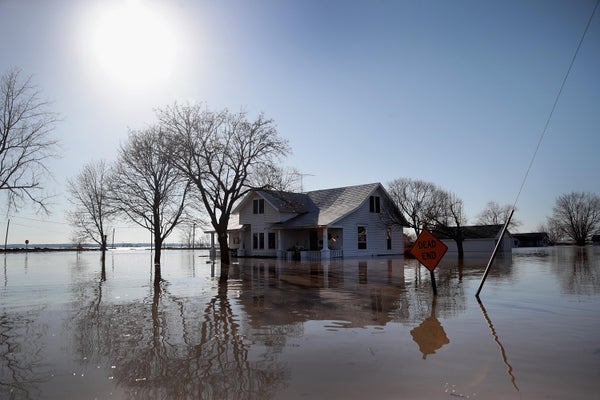
The Army Corps of Engineers plans a major study of ways to reduce flooding along the lower section of the Missouri River, where record precipitation and failed levees have devastated communities in the past year.
The study will analyze a 735-mile span of the nation's longest river and its tributaries — a stretch that runs from Nebraska's northeast corner to eastern Missouri, where the Missouri River empties into the Mississippi River.
Overflows and levee breaches have caused billions of dollars of damage since last March in Iowa, Kansas, Missouri and Nebraska. The federal government has declared major disasters in 321 of the 411 counties in those four states — 78% of the counties — making them eligible for emergency federal aid, Federal Emergency Management Agency records show.
On supporting science journalism
If you're enjoying this article, consider supporting our award-winning journalism by subscribing. By purchasing a subscription you are helping to ensure the future of impactful stories about the discoveries and ideas shaping our world today.
The flooding also has put pressure on the Army Corps to improve its management of the Missouri River's vast network of levees, dams and reservoirs to reduce flood damage.
The study "is recognizing the urgency that has been expressed to us by the states, and our own awareness of the challenges of managing a system like this," said Matt Rabe, a spokesman of the Army Corps' Northwestern Division, which will conduct the study.
Midwest officials hailed the Army Corps' move.
"We're pretty excited about it. We know we've got to do something different. We've just seen flooding more and more often," said Tom Waters, chairman of the Missouri Levee and Drainage District Association.
"We've got a system that's broken. It hasn't kept up over time with the amount of water that's coming down the river," added Waters, who testified before Congress in July.
Sen. Mike Rounds (R-S.D.) praised the Army Corps' study and said in a statement to E&E News: "We would like to see this study provide the Corps with recommendations on how to best construct a more resilient levee system in the future so communities along the Missouri River can avoid major flooding."
The study is significant for what the Army Corps will — and won't — investigate.
The Army Corps will focus on making flood controls along the lower Missouri River more resilient and on improving river flow so that high waters recede more quickly. Some Missouri River tributaries, such as the James River in South Dakota, remained at flood stages for nearly 300 days starting last year.
But the Army Corps does not plan to revise its river management strategy to emphasize flood control over other aims such as maintaining municipal water supplies, protecting endangered species and enabling barge traffic along the Missouri River. Midwestern lawmakers such as Sen. Chuck Grassley (R-Iowa) have pressed Army Corps leaders to make flood control the top priority along the Missouri River.
Brig. Gen. Peter Helmlinger, commander of the Army Corps' Northwestern Division, said at a Senate hearing in August that a study "would only be looking at flood-risk management measures with minimal, if any, negative impacts in navigation and other authorized purposes of the Missouri River projects."
"Such a study is critical if we are to prepare for the next major flood in this basin," Helmlinger added.
By concentrating on the Missouri River's lower 735 miles, the Army Corps largely will avoid focusing on the upper 1,600 miles, which run through the Dakotas and Montana and which include a series of massive reservoirs and dams that control the river's flow below Sioux City, Iowa.
Studying the lower section of the Missouri River is "low-hanging fruit," said Waters of the levee association, as it avoids regional clashes that could unfold if the Army Corps looked to revise its management of the entire 2,341-mile river.
"When you start talking about changing releases in the [Upper Missouri] reservoirs, then you start getting into the upper and lower basin squabble we've seen in the past. It gets a lot more difficult to get things done," Waters said.
The Army Corps began exploring a major Missouri River study shortly after a rare "bomb cyclone" dumped extensive rain on the Midwest and caused snow to melt earlier than usual. The conditions produced massive flooding across the region.
Army Corps officials said at the time that they would need Congress to authorize a comprehensive Missouri River study. But agency officials decided they had the authority to do the study on their own under the federal Flood Control Act, said Rabe, the spokesman.
Some details of the study are unknown, such as its cost, duration and funding source. The Army Corps is exploring various funding options — including using money it has on hand and seeking a new appropriation from Congress, Rabe said.
Reprinted from Climatewire with permission from E&E News. E&E provides daily coverage of essential energy and environmental news at www.eenews.net.