
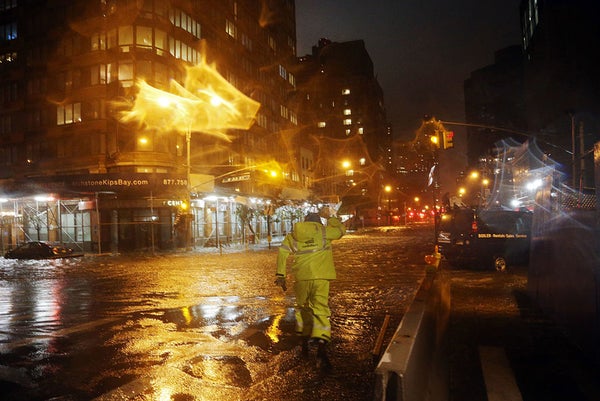
When Hurricane Sandy hit New York City in 2012, the storm destroyed more than US$20 million worth of scientific equipment at New York University’s (NYU) Langone Medical Center. Tropical storm Allison hit the University of Texas Health Science Center (UT Health) in Houston in 2001 and caused so much damage some researchers had to restart their careers elsewhere. Despite such catastrophes, a new report finds that many research institutions in the United States are still unprepared for disasters.
The report, released on August 10 by the US National Academies of Science, Engineering, and Medicine, looked at what happened to facilities during past disasters, interviewed people about how they had changed their current policies and procedures and consulted with experts on disaster and risk management. It recommends that universities and scientists take steps to protect biomedical research from emergencies of all scales, including natural disasters, fire, cyberattacks and terrorism.
Biomedical research is especially vulnerable to disasters, says lead author Georges Benjamin, executive director of the nonprofit American Public Health Association in Washington DC. While insurance companies may cover expensive machinery, resources such as strains of engineered mice and cells are irreplaceable and it’s difficult for insurance companies to quantify their value. Researchers at NYU lost 35,000 mice and rats, including 751 different lines of genetically modified animals that existed nowhere else.
On supporting science journalism
If you're enjoying this article, consider supporting our award-winning journalism by subscribing. By purchasing a subscription you are helping to ensure the future of impactful stories about the discoveries and ideas shaping our world today.
The report suggests 10 steps that researchers, institutions, and funding organizations can take to prepare for disasters and minimize the damage. While every institution has different needs, all should appoint a “central resilience officer” who can handle contingency plans for various scenarios. They should also institute mandatory training for staff to prepare them for emergencies.
Taking responsibility
One of the biggest problems is that many institutions house their animals in basements, often in an attempt to isolate the smell and to protect them from animal rights activists, says report co-author Bradford Goodwin, former animal facilities director at UT Health. But basements are susceptible to flooding, and can be difficult to evacuate in the event of an emergency.
Individual researchers should also take responsibility for protecting their own work, the report says. “You go into the lab every day and you worry about your lab work, but you’re making the assumption that everyone around you is protecting you,” Benjamin says. Rather, scientists should make sure their data is backed up off-site and work with their institutions to ensure that the most critical samples and resources are duplicated and stored at other locations.
It’s also important that institutions assess their individual risks and prepare for all types of potential disasters, say the report authors. For instance, California’s building codes already require lab buildings to withstand earthquakes. But research facilities on the US east coast, which was unexpectedly hit with an earthquake in 2011, may not be as resilient. And because climate change means that major storms and floods are becoming more common, Benjamin says, institutions should reassess whether their risk assessments are accurate.
The report adds that funders such as the National Institutes of Health should do more to help pay for redesigns and preparedness efforts. Institutions are becoming better about disaster preparedness, Goodwin says. But most people still think it’ll never happen to them, he says. “We’ve got to change that attitude.”
This article is reproduced with permission and was first published on August 10, 2017.