
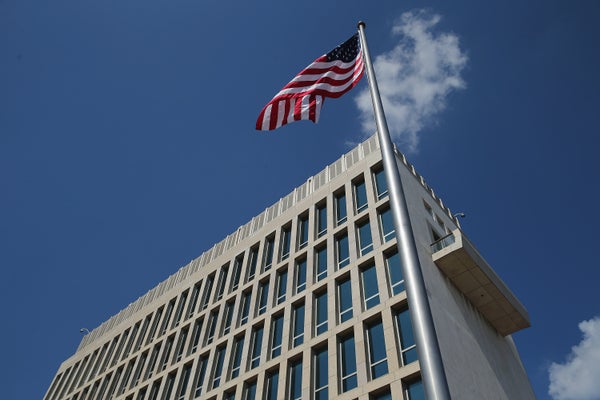
State Department personnel working at embassies and consulates around the world face heightened safety and security risks from climate disasters—particularly in countries ravaged by storms, heat and drought, say federal watchdogs.
Investigators with the Government Accountability Office found that the risk to “diplomatic assets" is rising at many of the State Department’s nearly 300 posts in 180 countries. More than half of the highest-risk facilities are in East Asia and the Pacific.
“According to State, the increasing number and severity of natural hazards due to climate change heightens the risk of damage to ... overseas locations (posts) and real property assets, including the office buildings, support facilities, and staff residences that comprise these posts,” GAO researchers found.
On supporting science journalism
If you're enjoying this article, consider supporting our award-winning journalism by subscribing. By purchasing a subscription you are helping to ensure the future of impactful stories about the discoveries and ideas shaping our world today.
GAO is an independent agency that works for Congress.
The embassy facing the greatest climate risk, according to the report, is located in Manila, Philippines, where the State Department employs roughly 300 U.S. foreign service officers at a sprawling compound on Manila Bay. The embassy has flooded twice over the last decade, first from a 2012 typhoon and more recently from an extreme rain last August, GAO said.
In all, 32 embassies ranked in the highest category for climate disaster risk, from Apia, Samoa, to Valletta, Malta. Others include some of the State Department’s largest and most strategic embassies, such as Beijing, Baghdad and Mexico City.
The American Embassy in Iraq is one of six in the Middle East facing the greatest risk. Cairo, Egypt, is also among the most vulnerable to extreme climate events.
The GAO report examined seven climate disaster types: tsunamis, extreme heat, extreme wind, coastal flooding, riverine flooding, landslides and water security. The bureau also assessed risk from earthquakes, which are not considered climate disasters. Between 2021 to 2035, the number of State Department overseas facilities affected by extreme heat could more than double, according to the report.
Investigators assigned risk scores to 294 embassies, consulates and other facilities with a combined property value of approximately $70 billion, GAO said. The scores were derived from risk screenings recently completed by the State Department’s Bureau of Overseas Buildings Operations (OBO) to meet President Joe Biden’s 2021 executive order for a governmentwide assessment of climate change risks to national security.
“OBO has the lead role in acquiring sites, designing, constructing, operating, and maintaining the embassies, consulates, staff housing, and support facilities that comprise U.S. diplomatic posts,” the report noted.
According to the agency, a typical embassy compound is in an urban area on a roughly 10-acre site. Often, U.S. staff housing is located close to or even within embassy grounds due to security concerns.
GAO said vulnerability factors may be specific to an embassy or consulate, including the age and condition of the facilities and ease of evacuation during a hazard, or countrywide, such as adequacy of a country or region’s power grid, clean water and sanitation availability, and access to health care.
In an official response, the State Department asked GAO to provide “any regional observations, interpretations, and conclusions proposed” in the report to help inform the “anticipated growth trajectory and necessary resourcing” for OBO’s climate security and resilience program.
Reprinted from E&E News with permission from POLITICO, LLC. Copyright 2022. E&E News provides essential news for energy and environment professionals.