
The US Department of Energy (DOE) has released new guidelines to protect researchers from political interference—a move that many say is long overdue.
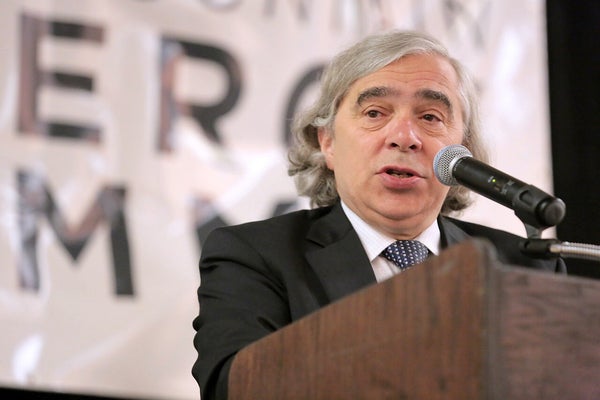
“DOE officials should not and will not ask scientists to tailor their work to any particular conclusion,” said energy secretary Ernest Moniz, who announced the guidelines on 11 January.
The plan allows scientists to publicly state their opinions on science and policy, as long as they make clear that they are not speaking for the government. It requires researchers to notify their supervisors if they speak to the media or publish their findings, but does not require them to seek approval for such activities.
On supporting science journalism
If you're enjoying this article, consider supporting our award-winning journalism by subscribing. By purchasing a subscription you are helping to ensure the future of impactful stories about the discoveries and ideas shaping our world today.
“It makes it absolutely clear that notification is the only thing required,” says Wendy Wagner, a law professor at the University of Texas at Austin. “The tenor of the entire policy seems to be full bore about giving scientists and technical people the complete freedom to speak about their research and how it intersects with policy.”
The plan—which applies to DOE employees, contractors and grant recipients—also calls for the department to appoint an independent ombudsperson to handle complaints.
That is a major shift from the DOE’s previous scientific integrity policy, issued in 2012. That policy applied only to DOE employees, and required them to coordinate with their supervisors before talking to the media and receive approval before publishing their findings in peer-reviewed journals.
Climate of fear
“The old policy was extremely vague, barebones and had no structure for implementation,” says Michael Halpern, deputy director of the Center for Science and Democracy at the Union of Concerned Scientists in Cambridge, Massachusetts. “When rights are not explicit, scientists that share personal opinions can be retaliated against.”
The revised guidelines come amidst concerns that president-elect Donald Trump’s administration will seek to limit federal support for science, including climate-change research. In December, Trump’s team asked the DOE for the names of employees who have worked on climate-change issues; the department refused and Trump staffers later disavowed the request.
Moniz says the new policy is not a response to that incident or to Trump’s election, and has been in the works for a while.
But Wagner thinks that the timing is significant. “The DOE might feel that if they don’t get this policy out now, it won’t be implemented,” she says.
But implementing the full plan is likely to fall to the administration of president-elect Donald Trump, who takes office on 20 January. His pick for energy secretary—former Texas governor Rick Perry—could soon be confirmed by the Senate.
“The Senate really needs to get details from Governor Perry, when they go through the confirmation process, about the specific implementation plans he has to ensure that this becomes a reality,” Halpern says.
This article is reproduced with permission and was first published on January 11, 2016.