
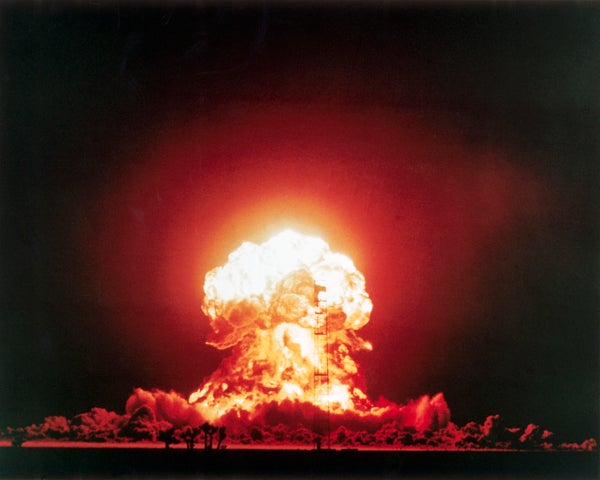
The United States is not prepared to deal with the aftermath of a major nuclear attack, despite North Korea’s efforts to develop nuclear weapons and the increasing tensions between nations overall. That was the blunt assessment of public-health experts who participated in a meeting last week on nuclear preparedness, organized by the National Academies of Sciences, Engineering, and Medicine.
The gathering is “an acknowledgement that the threat picture has changed, and that the risk of this happening has gone up”, says Tener Veenema, who studies disaster nursing at Johns Hopkins University in Baltimore, Maryland, and co-chaired the conference in Washington DC .
Since the fall of the Soviet Union in 1991, the United States’s research and preparedness efforts for a nuclear strike have focused largely on the possibility of a terrorist attack with a relatively small, improvised 1-kilotonne weapon or a ‘dirty bomb’ that sprays radioactive material.
On supporting science journalism
If you're enjoying this article, consider supporting our award-winning journalism by subscribing. By purchasing a subscription you are helping to ensure the future of impactful stories about the discoveries and ideas shaping our world today.
But North Korea is thought to have advanced thermonuclear weapons—each more than 180 kilotonnes in size—that would cause many more casualties than would a dirty bomb (see ‘Damage estimates’). “Now that thermonuclear is back on the table, we’re back to people saying, ‘We can’t deal with this,’” says Cham Dallas, a public-health researcher at the University of Georgia in Athens.
Veenema says that the science academies decided to do a study in November 2017, three months after North Korean leader Kim Jong-un threatened to launch a nuclear weapon at the U.S. territory of Guam. The academies wanted to bring together the different government, academic and private sectors that would be involved in the medical response to a nuclear attack, Veenema adds. The academies’ committee plans to release a report in December that lays out how the United States could plug the gaps in its response capabilities.
The U.S. government’s spending on nuclear-weapons research and response has dropped drastically over the past few decades—as has the number of health workers with training in radiation medicine and management. According to a 2017 study by Dallas, more than half of emergency medical workers in the United States and Japan have no training in treating radiation victims.
The same study suggests that even trained medical professionals might be too frightened to enter a nuclear-fallout zone or to treat radiation victims at the scene—Dallas’s group found that 33% of medical professionals said they would not be willing to respond in such a scenario.
Compounding these concerns, treatments for radiation exposure and burns might not be available in sufficient quantities in the aftermath of a nuclear attack. James Jeng, a burn surgeon at Mount Sinai Health System in New York City, says that the detonation of a nuclear bomb can leave behind hundreds of thousands of burn victims. The best treatment for such injuries is skin grafting, he says, but there are only about 300 burn surgeons in the United States who know how to perform the procedure. It might also be difficult to quickly transport enough donor skin to treatment sites, Jeng adds.
North Korea’s threat to Guam last year made clear to public-health officials there how limited their response capabilities are, says Patrick Lujan, emergency-preparedness manager for the Guam Department of Public Health and Social Services. Guam, an island of 163,000 people, has only three hospitals and no burn units. “We realized there’s just so much you can do, being on an island,” Lujan says.
This article is reproduced with permission and was first published on August 28, 2018.