
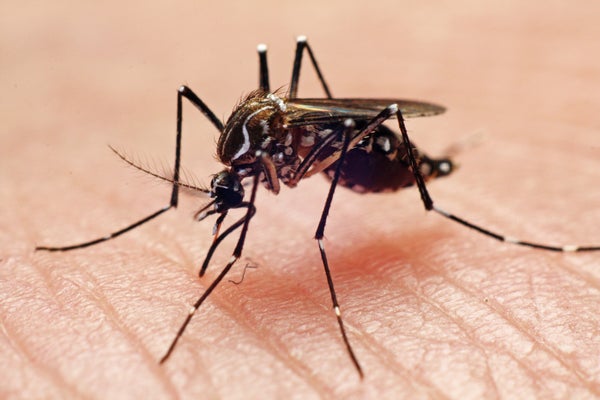
By Bill Berkrot
The U.S. National Institutes of Health said it will fund a study to monitor U.S. athletes, coaches and members of the Olympic Committee staff for exposure to Zika virus while in Brazil, with the hope of gaining better understanding of how it persists in the body and the potential risks it poses.
The study, announced on Tuesday, seeks to determine the incidence of Zika virus infection, identify potential risk factors for infection, evaluate how long the virus remains in bodily fluids, and study the reproductive outcomes of Zika-infected participants for up to one year.
On supporting science journalism
If you're enjoying this article, consider supporting our award-winning journalism by subscribing. By purchasing a subscription you are helping to ensure the future of impactful stories about the discoveries and ideas shaping our world today.
Brazil, which has been hardest hit by the mosquito-borne virus spreading across the Americas, will host the Summer Olympics in Rio de Janeiro next month.
The virus has caused concern because it can cause potentially severe birth defects in babies whose mothers were infected during pregnancy, including microcephaly - a birth defect marked by small head size that can lead to developmental problems. It has also been linked to Guillain-Barre, a rare neurological syndrome that can cause temporary paralysis in adults.
The connection between Zika and microcephaly first came to light last fall in Brazil, which has now confirmed more than 1,600 cases of microcephaly that it considers to be related to Zika infections in the mothers.
Zika is the first known mosquito-borne virus that can also be transmitted via unprotected sex with an infected male partner, leading to imprecise recommendations of how long couples should abstain or refrain from unprotected sex if the woman is pregnant or hoping to become pregnant.
Study participants will provide samples of bodily fluids to be tested for Zika and related viruses, such as dengue, which will help identify people who are infected but asymptomatic. As many as 80 percent of those who contract Zika do not display the classic symptoms, such as fever, rash and red eyes, researchers have said.
The U.S. Olympic study could help answer some of the big unknowns surrounding Zika, particularly the relative risks of asymptomatic versus symptomatic infections, and how long the virus remains present and transmittable in semen.
The study, which hopes to enroll at least 1,000 participants, is being headed up Dr. Carrie Byington of the University of Utah, who earlier this year began a pilot study of 150 participants, a third of whom said they or their partner planned to become pregnant within a year of the Olympics.
"We partnered with the USOC to improve knowledge of the dynamics of Zika infection, so that we can better protect the health of athletes and staff who will participate in the 2016 Games," Byington said in a statement.
The USOC had previous said it will provide several months worth of condoms to its athletes and staff heading to Brazil for the games.