
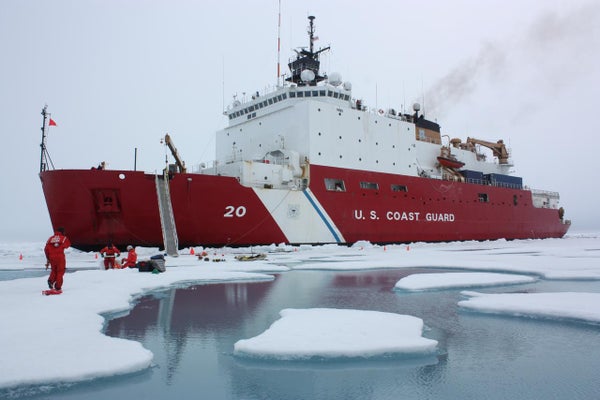
The Coast Guard says it's making good progress in the Arctic, an unusually upbeat assessment after years of warning that a warmer North Pole will attract more ships than the coasties can handle.
Those new assurances were cold comfort to lawmakers and experts at yesterday's House Transportation subcommittee hearing, who portrayed the United States as lagging behind other global powers that recognize climate change will transform the Arctic into a critical hub for shipping, fishing and drilling.
As Congress begins paying for the country's first heavy icebreaker since the Carter administration, most observers say the United States still lacks the infrastructure, equipment and basic maps it needs to handle an influx of commercial activity in the Arctic—let alone the Russian and Chinese efforts to project power up to the North Pole.
On supporting science journalism
If you're enjoying this article, consider supporting our award-winning journalism by subscribing. By purchasing a subscription you are helping to ensure the future of impactful stories about the discoveries and ideas shaping our world today.
"Just like 9/11, we have a failure of imagination," said David Titley, a retired Navy rear admiral who's now a professor at Pennsylvania State University. "We have never been in a position in the modern world where access to an entire ocean opened up within a matter of decades."
Coast Guard and Maritime Transportation Subcommittee Chairman Duncan Hunter (R-Calif.) blasted the Pentagon's new National Defense Strategy for excluding the Arctic as "really myopic and shortsighted." He added that efforts are underway in the House and Senate to use the National Defense Authorization Act to require the Navy to coordinate Arctic strategy with the Coast Guard.
The Navy plans to release a new Arctic plan this summer, but lawmakers say a meeting organized by Rep. Garret Graves (R-La.) with Navy brass this week left them cold.
"The Navy has no interest," said Rep. John Garamendi (D-Calif.). "Yesterday's meeting that Mr. Graves put together was shocking, in that the Navy has simply abandoned the Arctic Ocean other than submarines."
Adm. Charles Ray, vice commandant of the Coast Guard, told lawmakers there was "no air" between Navy and Coast Guard planning.
"With your support, I'm pleased to report the Coast Guard is making progress, operationally and strategically, to achieve year-round access in the Arctic," Ray said, tallying benchmarks like 28 search-and-rescue operations and visiting 41 remote villages.
This year's spending agreement allowed the Coast Guard to begin purchasing the first of three new heavy icebreakers. It currently operates one heavy vessel, the 42-year-old Polar Star, and one medium-sized ship, the Healy. (Another heavy ship, the Polar Sea, is broken beyond repair; the Coast Guard uses it for spare parts to keep the Polar Star afloat.)
The Arctic has been warming about twice as fast as the rest of the planet, tempting commercial and tourist ships into the region. Last year, three cruise ships sailed off Alaska's north coast, and some analysts estimate the Arctic could become a commercially attractive route by the 2040s.
The warmer temperatures make icebreakers even more important, as thicker ice breaks free and travels in unpredictable ways (Climatewire, March 21).
American icebreaker capability has been declining as other countries rev up. Russia has 46 icebreakers in government and commercial service, with another 15 in the pipeline, according to the Congressional Research Service. China is constructing its second icebreaker, complementing a polar strategy that includes a role in the Arctic Council along with commercial and scientific toeholds in Greenland.
"Russia and China view the Arctic over the next half-century. We view it in [terms of] the next budget cycle," said Heather Conley, an Arctic specialist at the Center for Strategic and International Studies.
She added that one reason China is interested in the Arctic is the theory, still debated among scientists, that rising temperatures in the far north heavily influence weather patterns in the mid-latitudes.
Rep. Don Young (R-Alaska) said new shipping lanes demonstrate that "we do have a changing climate, I think for the better. ... [W]e have a new opportunity."
But those opportunities will slip by without more ports, communication capabilities and better government coordination, he said.
"We're sort of out in the middle of la-la land right now," Young said.
Reprinted from Climatewire with permission from E&E News. E&E provides daily coverage of essential energy and environmental news at www.eenews.net.