
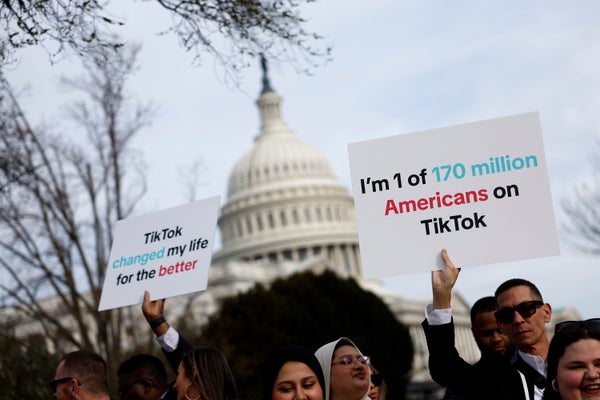
About 170 million people use TikTok in the U.S., but that number could abruptly plummet toward zero if a law signed by President Joe Biden goes into effect on January 19. The law forces a choice for ByteDance, the China-based company that owns TikTok: it must either sell the app to a non-Chinese company or face a ban. ByteDance has repeatedly said the app is not for sale.
Instead the company sued to keep the TikTok app available in the U.S.—and that case has now made its way before the Supreme Court. In oral arguments on Friday, Noel Francisco, attorney for ByteDance’s U.S. subsidiary TikTok, Inc., argued that the new law violates the First Amendment rights of that subsidiary, likening TikTok’s curation algorithm to editorial discretion. U.S. solicitor general Elizabeth Prelogar, arguing on behalf of the nation’s government, countered that China does not have a First Amendment right to manipulate content in the U.S. And she claimed that “the Chinese government could weaponize TikTok at any time to harm the United States.”
The Supreme Court is expected to issue a decision within the next nine days.
On supporting science journalism
If you're enjoying this article, consider supporting our award-winning journalism by subscribing. By purchasing a subscription you are helping to ensure the future of impactful stories about the discoveries and ideas shaping our world today.
Why is the clock ticking for TikTok?
Congress, which passed the TikTok law with bipartisan support, says China’s influence over the platform poses a national security threat. The Department of Justice has raised concerns as well, including the potential collection of personal data from the app’s millions of American users and the potential “covert manipulation” of its content. (Although there is evidence that ByteDance shared non-U.S. user data with China, the U.S. government has not provided direct proof that the company or its subsidiary have meddled with American users.)
What might happen?
If TikTok loses its case, “as I understand it, we go dark,” Francisco told the Supreme Court on Friday. Americans would no longer be able to download or update TikTok from Google’s or Apple’s app stores. Internet service providers, too, would face severe penalties if they permitted TikTok access to U.S. users.
Americans may react in similar ways as former TikTok users elsewhere. After India banned the app in 2020, users flocked to other forms of short-form video, such as Instagram reels and YouTube Shorts. It is also possible to access blocked content via virtual private networks, or VPNs, which could disguise traffic to make it appear to originate from a country where TikTok wasn’t banned.
President-elect Donald Trump, meanwhile, has asked the Supreme Court to delay interpreting the law until he takes office. An amicus brief filed on his behalf claims his “consummate dealmaking expertise” could save the platform while addressing the national security concerns. Last September Trump promised to save the app, posting on his social media network Truth Social, “FOR ALL OF THOSE THAT WANT TO SAVE TIK TOK IN AMERICA, VOTE TRUMP!” Legal scholars have criticized Trump’s request for a delay.
Is the possible TikTok ban legal? Is it security theater?
Civil liberties and free speech organizations oppose the ban, contending that it violates Americans’ rights under the First Amendment. “Restricting citizens’ access to foreign media is a practice that has long been associated with the world’s most repressive regimes, and it would be deeply unfortunate if the Supreme Court let this practice take root here,” said Jameel Jaffer, executive director of the Knight First Amendment Institute, in a news release issued by the institute on Thursday.
Some free speech experts have argued that such a TikTok ban is more about political posturing than protecting users. Such a move does little to stop data brokers from selling U.S. users’ information, whether to overseas tech companies or intermediaries who, in turn, can sell it to foreign governments. “Banning access to one application does not create safety or security for Americans’ data from China or from any other country,” said Kate Ruane, an attorney at the Center for Democracy and Technology (CDT), a nonprofit civil rights organization, in an interview with Scientific American last year.