
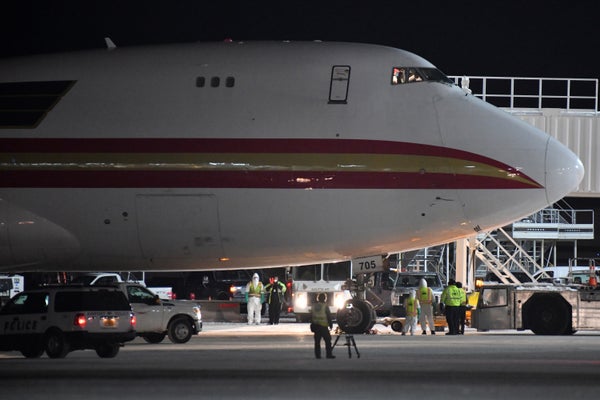
U.S. health officials said Friday they would quarantine 195 U.S. citizens who were evacuated from Wuhan, China, amid an outbreak of a novel coronavirus—the first time in 50 years the Centers for Disease Control and Prevention has taken such action.
The order will be effective for 14 days from the date of evacuation.
Dr. Nancy Messonnier, director of CDC’s National Center for Immunization and Respiratory Diseases, told reporters health officials were prepared for the possibility that the outbreak of the coronavirus could become a pandemic—the worldwide spread of a disease. “We are preparing as if this is the next pandemic,” she said, stressing that the agency hoped it would not become one.
On supporting science journalism
If you're enjoying this article, consider supporting our award-winning journalism by subscribing. By purchasing a subscription you are helping to ensure the future of impactful stories about the discoveries and ideas shaping our world today.
“If we take strong measures now, we may be able to blunt the impact of the virus on the United States,” Messonnier said.
She added: “Please do not let fear or panic guide your actions.”
The passengers arrived at March Air Reserve Base in Southern California Wednesday after being flown from Wuhan, with a stop in Anchorage. The passengers had been monitored for symptoms—including cough and fever—before, during, and after the flight.
U.S. officials said Wednesday that all passengers had volunteered to stay at the base in isolation for a few days while they could be assessed, but one person tried to leave the base that night and was placed under a 14-day quarantine by local authorities.
The federal quarantine issue was ordered for a number of reasons, CDC officials said. Among them: the number of confirmed cases and deaths in China has jumped every day this week; more countries are reporting infections, including incidents of human-to-human transmission of the virus; and evidence documented this week by German researchers that showed a person with no symptoms of the virus passing it on to others.
The virus, known provisionally as 2019-nCoV, has caused nearly 9,700 confirmed infections and killed 213 people in China. About 100 additional infections have been reported in 18 other countries, and no deaths. The large majority of cases outside China came from people who picked up the virus in China and then traveled to the other countries.
CDC officials framed the quarantine decision as the best way to preclude the potential spread of the virus to the people’s families and communities. They said that monitoring the people for 14 days also meant that should any of them become sick, they can be quickly identified.
CDC scientists have developed a test for the coronavirus, but Messonnier said it might not be advanced enough to detect the virus if people are not showing symptoms yet. The quarantine is set for 14 days because that is the longest amount of time the virus is thought to be able to “incubate” in a person before creating symptoms.
Quarantining people involves restricting the movements of people who may have been exposed to a pathogen but are not yet sick; it is different than isolation, which refers to containing people who are sick. The last time a federal quarantine order was issued for potential cases was in the 1960s for smallpox evaluation, CDC officials said.
The CDC also confirmed Friday that China had agreed to allow some of its experts into the country “to support” the Chinese response and help study the transmission of the virus and the range of severity seen with infections, a spokesperson said. The World Health Organization is sending another mission to China to collaborate on the response and investigation.
The repatriated passengers had been evacuated from Wuhan, the central Chinese city of 11 million people where cases of the virus were first documented last month and where the outbreak is centered. U.S. officials arranged the flight as the virus spread and China imposed lockdowns on Wuhan and other cities, shutting down travel to and from the areas and essentially quarantining tens of millions of people.
One person with a fever was not allowed to board the flight in Wuhan, U.S. officials said Wednesday.
Messonnier called the quarantine “an unprecedented action.” But, she said, “we are facing an unprecedented public health threat.”
CDC officials acknowledged that a quarantine came with downsides, including the potential for fear and for the stigmatization of people under quarantine. “We’re taking every measure to make sure people are treated with dignity and respect,” said Dr. Martin Cetron, CDC’s director of global migration and quarantine.
There have been six confirmed U.S. cases of the coronavirus infection. Five were travel-related. The sixth, announced Thursday, marked the first U.S. case of human-to-human transmission; one of the travel-related cases, a woman in Illinois, transmitted the virus to her husband before she was isolated.
U.S. health officials have said since the outbreak started that they expected travel-related cases and for some of those patients to pass the virus on to their close contacts. If they can restrict the virus to cases of limited spread among contacts and prevent the virus from circulating more broadly, it is much easier to snuff out the virus.
On Thursday, the State Department increased its travel warning to Americans, urging them to avoid travel to China. Secretary of State Mike Pompeo cited the WHO’s declaration of the outbreak as a global health emergency as part of the rationale for the warning. But WHO officials have stressed the declaration was being made to encourage countries not to impose travel and trade restrictions on China.
Several airlines have halted flights to and from the Chinese mainland, including, as of Friday, American, Delta, and United.
Republished with permission from STAT. This article originally appeared on January 31 2020