
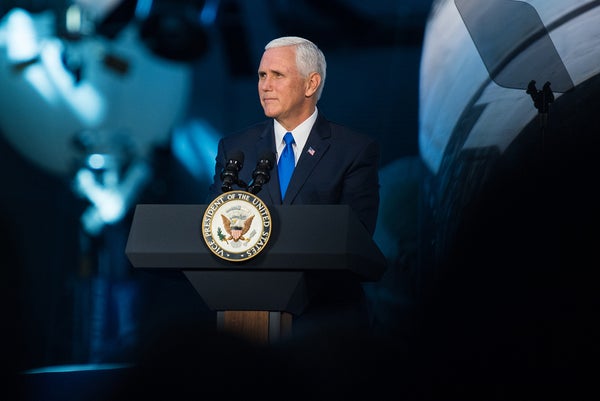

The Trump administration is committed to sending astronauts to the moon as part of a broader push to prioritize human spaceflight and firm up U.S. dominance in the final frontier, Vice President Mike Pence said.
"We will return American astronauts to the moon, not only to leave behind footprints and flags, but [also] to build the foundation we need to send Americans to Mars and beyond," Pence said today (Oct. 5) at the first meeting of the newly reinstated National Space Council (NSC).
"The moon will be a stepping stone, a training ground, a venue to strengthen our commercial and international partnerships as we refocus America's space program toward human space exploration," Pence added. [From Ike to Trump: Presidential Visions for Space Exploration]
On supporting science journalism
If you're enjoying this article, consider supporting our award-winning journalism by subscribing. By purchasing a subscription you are helping to ensure the future of impactful stories about the discoveries and ideas shaping our world today.
Under the previous administration, that stepping stone was much smaller: President Barack Obama had directed NASA to prep for Mars trips by visiting a near-Earth asteroid. In response, the space agency devised a plan to pluck a boulder off a space rock and haul that fragment into orbit around the moon.
A new direction?
Yesterday (Oct. 4) was the 60th anniversary of the launch of Sputnik 1, which kicked off the Space Age and the Cold War space race. Pence referenced that seminal event during his remarks today, while lamenting a perceived lack of direction in U.S. space policy.
"Rather than lead in space, too often, we've chosen to drift," he said. "And, as we learned 60 years ago, when we drift, we fall behind."
As evidence of this drift, Pence cited the fact that NASA astronauts haven't gone beyond low-Earth orbit since the final Apollo moon mission, in 1972. In addition, he noted, the country has had to pay Russia to ferry U.S. astronauts to the International Space Station since the space shuttle retired in 2011. That service currently costs $76 million per seat. (Two U.S. companies, SpaceX and Boeing, are both developing capsules to take over this taxi service for NASA astronauts; these spacecraft could begin crewed flights next year.)
Pence pledged that the Trump administration, with the help of the NSC, will develop and implement a coherent, long-term U.S. space strategy.
That strategy will focus heavily on human spaceflight, economic development and national security, if Pence's words today and in an op-ed published yesterday in The Wall Street Journal are any guide.
"We will renew America's commitment to creating the space technology needed to protect national security. Our adversaries are aggressively developing jamming and hacking capabilities that could cripple critical military surveillance, navigation systems and communication networks. In the face of this threat, America must be as dominant in the heavens as it is on Earth," Pence wrote in the op-ed. (A subscription is required to read the full piece, but some snippets are available for free at whitehouse.gov.)
"We will promote regulatory, technological and educational reforms to expand opportunities for American citizens and ensure that the U.S. is at the forefront of economic development in outer space," he added. "In the years to come, American industry must be the first to maintain a constant commercial human presence in low-Earth orbit, to expand the sphere of the economy beyond this blue marble."
The first meeting
The primacy of these stated goals was reflected in the makeup of the panelists at today's meeting, which was held at the Smithsonian National Air and Space Museum's Steven F. Udvar-Hazy Center in Chantilly, Virginia. (The space shuttle Discovery is on display at Udvar-Hazy, providing a dramatic backdrop.)
Two of the three panels consisted of executives of the spaceflight companies SpaceX, Blue Origin, Sierra Nevada Corp., Lockheed Martin, Boeing and Orbital ATK. The third panel focused on national security and featured retired Navy Adm. James Ellis, the former chief of U.S. Strategic Command; former NASA astronaut and former DARPA (Defense Advanced Research Projects Agency) Deputy Director Pamela Melroy; and former NASA Administrator Michael Griffin.
"We won the race to the moon half a century ago, and now we will win the 21st century in space," Pence said at today's meeting, a full replay of which you can see here.
The NSC was last active in the early 1990s, during the presidency of George H.W. Bush. President Trump resurrected the council via executive order on June 30.
Follow Mike Wall on Twitter @michaeldwall and Google+. Follow us @Spacedotcom, Facebook or Google+. Originally published on Space.com.
Editor's Recommendations
Copyright 2017 SPACE.com, a Purch company. All rights reserved. This material may not be published, broadcast, rewritten or redistributed.