
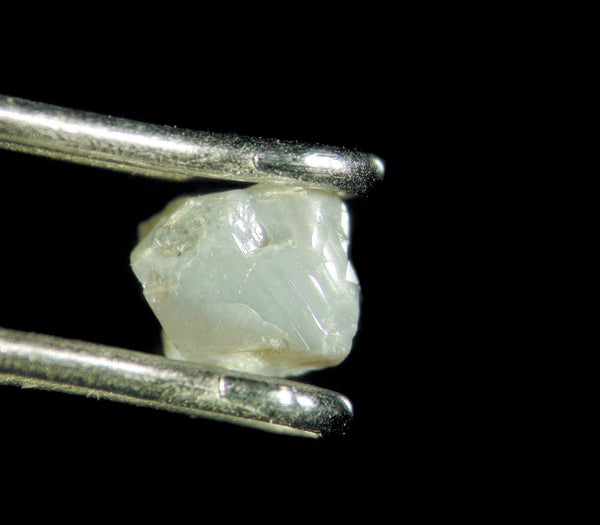
Cloudy, yellowish “fibrous diamonds” are too unsightly for most jewelers. But for scientists, their crystalline structure holds valuable secrets stretching back a billion years or more.
Yaakov Weiss, an earth scientist at the Hebrew University of Jerusalem, and his colleagues crushed portions of South African fibrous diamonds to extract tiny pockets of fluid trapped within. This fluid, from which the diamonds once formed, holds a unique record of long-ago conditions deep within Earth. It also contains uranium and thorium, which decay into the isotope helium 4 and gradually leak out of the diamond’s crystalline lattice. But nobody knew the precise leakage rate, which would be needed to determine the diamonds’ age and unlock the history within.
By modeling this decay and how much helium 4 leakage is possible over time, Weiss and his colleagues determined a broad age range for the stones. They then ruled out ages that would be impossible based on known tectonic and thermal conditions in Earth’s mantle and crust at the diamonds’ formation site. Combining these data yielded an upper limit on leakage, which the researchers could apply to all fibrous diamonds they studied. They recently described their results in Nature Communications.
On supporting science journalism
If you're enjoying this article, consider supporting our award-winning journalism by subscribing. By purchasing a subscription you are helping to ensure the future of impactful stories about the discoveries and ideas shaping our world today.
The team dated the fluid back to three separate periods, each coinciding with big changes at the surface. The oldest diamonds were found to be between 750 million and 2.6 billion years old; the scientists narrowed their creation down to about a billion years ago, when tectonic forces were building rugged mountains in what is now South Africa. The next oldest formed 300 million to 540 million years ago, coinciding with the formation of Namibia’s Naukluft Mountains. The youngest formed between 85 million and 118 million years ago, just before a subsurface eruption blasted them toward the upper crust.
Additionally, the fluid was carbon-rich in the oldest diamonds, heavy in silica in the next oldest, and saline-rich in the youngest. This might also echo significant geologic changes: for instance, the youngest fluids may have come from oceanic crust being pushed deep into Earth as the oceanic plate slid under the continental crust.
No other deep-Earth rock or mineral reaches the surface with as few interior alterations as a diamond, says University of Alberta earth scientist Suzette Timmerman, who was not involved in the study. The fluids thus offer a rare, direct window into the deep lithosphere (crust) and upper mantle. “Whatever is inside is basically a time capsule,” Timmerman says.
Next, the researchers plan to check diamonds from other regions for similar correlations between formation and big surface events, Weiss says: “We’ll need to think about what exactly this says about the evolution of the mantle and the lithosphere.”