
Rather than chasing their prey in flight like many other birds, Acadian flycatchers prefer to ambush insects from a perch. Researchers recently discovered an odd structure in the birds' eyes that may help them track a moving insect while sitting still themselves.
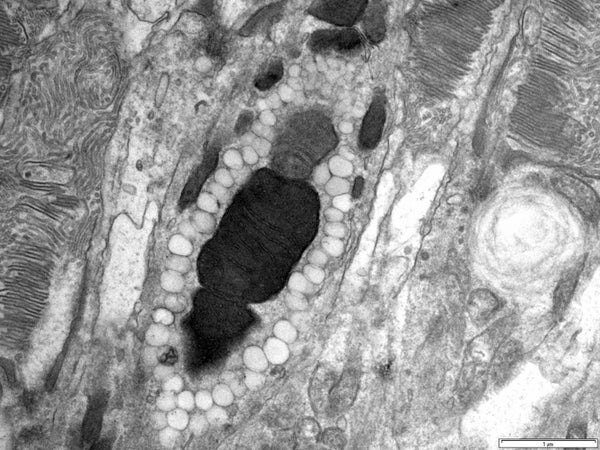
Visual ecologist Luke P. Tyrrell of the State University of New York Plattsburgh and his colleagues found that the photoreceptors, or light-sensitive cells, at the center of the flycatcher's retina contain extralarge mitochondria. These components (which produce energy for cells) are each surrounded by hundreds of oil droplets, forming an elongated blob. Scientists have previously observed large mitochondria in the eyes of zebra fish and tree shrews, and many birds' photoreceptors contain oil droplets for modifying light. But biologists had never before observed an optical arrangement like the flycatcher's.
The structure “comes as a bit of a shock,” says Joseph Corbo, a visual scientist at Washington University in St. Louis, who was not involved in the study. “It's just out of the blue. There's nothing in any species, bird or otherwise, that has this distinctive sort of rocket-ship shape.”
On supporting science journalism
If you're enjoying this article, consider supporting our award-winning journalism by subscribing. By purchasing a subscription you are helping to ensure the future of impactful stories about the discoveries and ideas shaping our world today.
Some other birds' photoreceptors contain oil droplets—but usually just a single large one, Tyrrell notes. In the flycatcher's case, “there are hundreds or thousands of them, and they're super tiny and packed around these mitochondria, which is also very abnormal,” he says. “Almost like packing peanuts.” Tyrrell posted the study on the preprint server bioRxiv in February and has since submitted it to peer-reviewed journals.
The oil droplets filter out shorter wavelengths of light, allowing only longer ones (oranges and reds) to pass through. The researchers think these wavelengths might prompt certain enzymes in the mitochondria to produce more energy for the retinal cell, as researchers have previously demonstrated with mice, Tyrrell says. “That energy could be used for the cell to fire more times per second,” he explains. “It's like a higher frame rate on a camera.” He says this might allow the flycatcher to track fast-moving prey more effectively.
Corbo urges caution in speculating about the structure's energy-boosting role, noting that if such a specialized adaptation exists for that reason, it would likely be more widespread among bird species. He is not sure what function it might have beyond filtering and funneling the different wavelengths of light for some other purpose. “I would guess this is [just] a kind of fancy, modified oil droplet,” he says. Tyrrell and his colleagues found the retinal structure in the least flycatcher as well. He is now investigating whether birds closely related to these flycatchers have similar structures.*
*Editor’s Note (9/24/19): This paragraph was edited after posting to clarify that the structure was also found in the least flycatcher.