
It's remarkable how often seemingly pedestrian things ultimately spark a sense of wonder when considered through the evidence-based view of research. Take the question of how we see faces, a ho-hum everyday occurrence that we easily do without conscious effort. Yet it is a feat full of puzzling intricacies that investigators are attempting to parse. How do the networks in the brain put various features into recognizable faces and, eventually, assemble a sensible picture of the world?
In this issue's cover story, “Face Values,” neuroscientist and MacArthur Fellow Doris Y. Tsao describes her journey into this field of study. It began in her high school calculus course using differential equations to describe curves and continued in undergraduate studies—where she learned early experiments in how the primary visual cortex extracts edges from images—and graduate school. “I was captivated by the challenge of understanding vision and embarked on a quest,” Tsao writes.
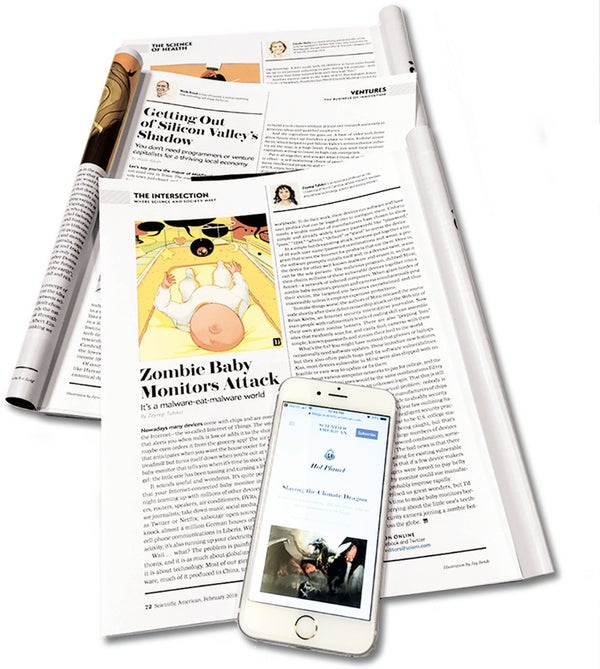
Using our visual systems, we're also seeing—and welcoming—some new faces to Scientific American, as part of our ongoing refinement of editorial content. First of all, we've added some new advisers to our board below; their insights are invaluable to our science coverage. In addition, in recent months we've been joined by Claudia Wallis as the “Science of Health” columnist, as well as by climate scientist Kate Marvel, who writes “Hot Planet” on ScientificAmerican.com.
On supporting science journalism
If you're enjoying this article, consider supporting our award-winning journalism by subscribing. By purchasing a subscription you are helping to ensure the future of impactful stories about the discoveries and ideas shaping our world today.
In this issue, technosociologist Zeynep Tufekci shares her expertise. Her monthly column, “The Intersection,” promises to cover critical issues that occur “where science and society meet.” Her first essay, “Zombie Baby Monitors Attack,” sheds light on “blatantly negligent security practices” that could undermine the Internet of Things. Also penning his first monthly installment is technology journalist Wade Roush. He will be writing “Ventures,” covering “the business of innovation.” In “Getting Out of Silicon Valley's Shadow,” he discusses whether local economies need an economic injection from a so-called innovation district or technology cluster. The future awaits.