
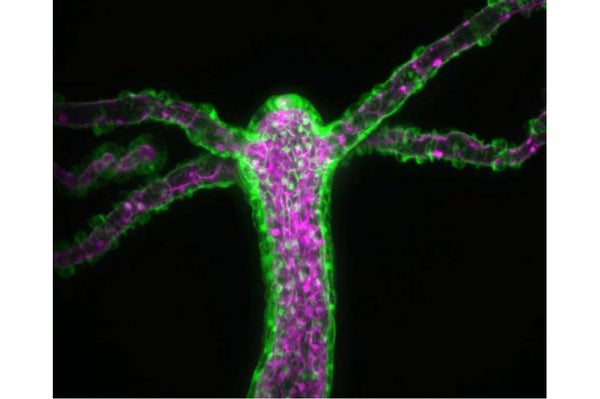
The hydra, a small freshwater creature, tears itself apart every time it gets hungry. Rather than have lips, the hydra’s mouth is a sealed piece of intact skin that it tears open to gobble each meal. In a new study, biophysicists have filmed hydras as they create these temporary rips, showing for the first time how its cells manage the maneuver. The findings, reported today in Biophysical Journal, may offer clues into tissue regeneration.
On supporting science journalism
If you're enjoying this article, consider supporting our award-winning journalism by subscribing. By purchasing a subscription you are helping to ensure the future of impactful stories about the discoveries and ideas shaping our world today.
Lacking bones and measuring less than half an inch long, hyrdra live underwater, with one end of their tubular bodies usually attached to a plant stem. Their free end is marked by tentacles with stingers, which are used to spear prey like microscopic crustaceans and copepods.
“When we started looking at the animals feeding, we were really struck by the fact that it can open its mouth wider than its body,” said Eva-Maria Collins, a physicist and cell biologist at the University of California San Diego who led the study. “And while it is very well-understood what can trigger the opening of the hydra mouth, nobody actually knows how it achieves this feat.”
Collins’ team tweaked the genetics of a species called Hydra vulgaris, so its skin would fluoresce under a microscope. Hydra skin has two layers, the outer ectoderm and the inner endoderm, which the team labeled with the colors green and magenta, respectively.
“What was really astounding is that the cells are not moving relative to each other. Each cell keeps its neighbor as the hydra is opening its mouth,” Collins said. Instead, these cells stretch.
The cells in the hydra’s mouth start round, and then deform dramatically, pulling on each other to make this mouth as wide as possible. When most animals create an opening like this one, cells typically move out of the way. But hydra cells prefer stretching like they’re in yoga class.
It’s musclelike cells in the mouth’s outer layer that cause this stretching to happen, the scientists found. These musclelike fibers are arranged in circle, and when the fibers contract, they tug on the skin cells and cause stretching. The process is similar to how muscles in the iris of a human eye contract to widen a pupil. When the researchers added a muscle relaxant — magnesium chloride — the hydras couldn’t open their mouths at all.
Collins’ team observed that hydras, even with a relatively simple nervous system, could open their mouths to different degrees — sometimes narrower, sometimes wider. Her team plans to dig into this connection with the nervous in future studies.
“We still have a lot of work to do to really understand how signals from the nervous system trigger mouth opening,” she said. “And then we also would like to understand how the mouth closes and what the consequences are for the individual cells to accommodate this amazing stretching, which can be more than 100 percent strain.”
This article is reprinted with permission from PBS NewsHour. It was first published on March 8, 2016.