
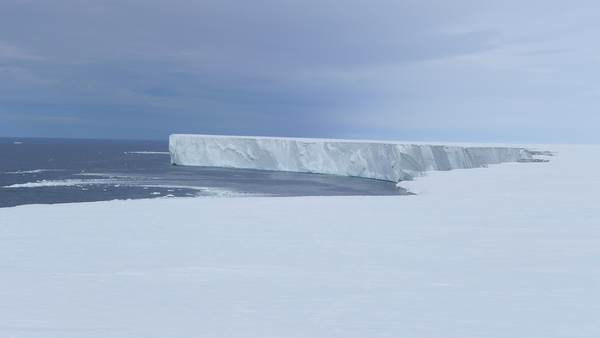
Part of Antarctica’s Ross ice shelf—the largest ice shelf in the world—appears to be melting 10 times faster than the ice around it. And researchers say a new process, one that was only rarely considered by scientists in the past, is the likely culprit.
The findings, published yesterday in the journal Nature Geoscience, point to warm ocean water, heated up by the sun at the surface of the sea, as the driver behind the melting.
It sounds deceptively simple, but it’s actually a process that hasn’t been well documented until now. Scientists know the ocean has an important influence on the melt rates of some Antarctic glaciers, but most recent research has focused on deep-sea currents rather than surface water. Scientists are finding that some deep currents—potentially driven by processes influenced by climate change—are helping drive masses of relatively warm water up to the edge of the ice sheet in certain regions of Antarctica, melting glaciers from the bottom up (Climatewire, April 10, 2018).
On supporting science journalism
If you're enjoying this article, consider supporting our award-winning journalism by subscribing. By purchasing a subscription you are helping to ensure the future of impactful stories about the discoveries and ideas shaping our world today.
But in this case, the researchers are pointing instead to the simple influence of the sun.
Near the front of the Ross ice shelf, there’s a round patch of ocean that tends to remain relatively clear of sea ice, even while the rest of the water around it is covered. It’s a natural phenomenon known as a “polynya” that occurs in various parts of both the Arctic and Southern oceans, typically formed by polar wind patterns.
Sea ice helps to block sunlight from reaching the water it covers. But when the water is clear, as in the case of polynyas, it tends to soak up more heat. The Ross polynya is a prime example, as the new research demonstrates.
The researchers, led by Craig Stewart of the National Institute of Water and Atmospheric Research in New Zealand, relied on a combination of radar mapping to measure the rate of melting on the Ross ice shelf and direct observations of the ocean from instruments they deployed in the sea. They found that a particularly vulnerable region of the Ross ice shelf, close to the ice front, is melting at intense rates—about an order of magnitude faster than the rest of the ice shelf.
The area with the highest melting happens to be a thin, but important, section of the ice shelf that helps stabilize the flow of the ice behind it. If it were to give way, the region’s rate of ice loss could substantially accelerate.
The ocean instruments suggest that the melting is largely influenced by the flow of warm, sun-heated surface water from the nearby Ross polynya, particularly during the Antarctic summer.
‘Overlooked, but potentially important’
Measurements of sea surface temperatures around Antarctica suggest that few parts of the Southern Ocean warm up to the temperatures observed near the Ross ice shelf. As a result, the scientists write, “this process does not seem to be widespread at present.”
But that could change with future warming.
As temperature continue to rise, “the projections are for a reduction in the amount of sea ice around Antarctica,” said climate scientist Laurence Padman, a senior scientist with nonprofit Earth & Space Research, who commented on the new research for E&E News. With more of the liquid ocean exposed to radiation from the sun, the water could potentially absorb enough heat to speed up melting on other parts of the Antarctic ice sheet.
There are plenty of other climate-related factors to take into account, as well, Padman added. Potential changes in Antarctic clouds, wind patterns or ocean currents may also affect the amount of heat the water is able to absorb in the future.
But in general, he said, “if the sea ice was to thin out in front of another ice shelf, then there would be more opportunity for this type of melting to occur.”
It’s a process the authors of the new study say represents a “frequently overlooked, but potentially important, factor” in the future stability of Antarctic ice shelves.
The concept itself isn’t completely new. According to Padman, researchers have hypothesized for decades that warming surface waters could have an impact on Antarctic melt rates. Some scientists have even begun trying to incorporate the process in models of the ice sheet’s response to climate change.
But scientists are just beginning to document the phenomenon in the field. Padman has conducted similar research on the Ross ice shelf and has also found that sun-heated surface waters are playing a key role in some of its regional melting. He presented some of those findings in December at the annual conference of the American Geophysical Union.
As far as the Ross ice shelf is concerned, research generally suggests that it’s stable for the time being, despite the high melt rates in some regions. The ice that’s being lost is still largely being replaced by accumulating snowfall and more ice flowing in from farther inland, keeping the region in a relatively steady state.
Still, a substantial increase in future melting could potentially throw the region out of balance. And in general, the influence of declining sea ice and warming surface waters is an important emerging consideration, according to Padman.
“It is something to be worried about in terms of it’s a way of changing basal melt rates quickly in the future, and ... it doesn’t really come up very often in Antarctic studies, or at least in the press versions of Antarctic studies,” he told E&E News. “And so it’s worth highlighting and having people get motivated to think about it.”
Reprinted from Climatewire with permission from E&E News. E&E provides daily coverage of essential energy and environmental news at www.eenews.net.