Universe Now Twice as Bright
Astronomers have long known that interstellar dust—microscopic grains made of carbon and silica—obscures starlight by soaking it up and reradiating it as infrared.
On supporting science journalism
If you're enjoying this article, consider supporting our award-winning journalism by subscribing. By purchasing a subscription you are helping to ensure the future of impactful stories about the discoveries and ideas shaping our world today.
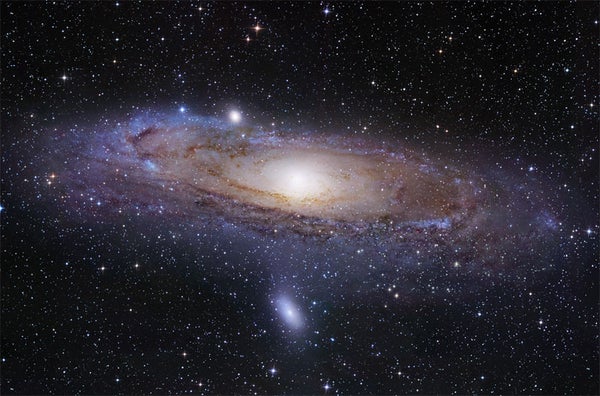
Astronomers have long known that interstellar dust—microscopic grains made of carbon and silica—obscures starlight by soaking it up and reradiating it as infrared. They estimated that dust might block about 10 percent of the total light in the universe. It looks like they were way, way off. In a new study, a team of European astronomers exploited the observation that dust builds up in the plane of a galaxy, not its center, meaning it blocks more light when galaxies are viewed edge on. So they tallied the number of galaxies visible either edge on or face on in the 10,000-galaxy-strong Millennium Galaxy Catalogue. Edge-on galaxies were less common than face-on galaxies by a whopping 70 percent, they report in May 10's The Astrophysical Journal Letters. Combined with models of dust distribution, the result suggests that dust blocks nearly half the light in the universe.
It’s Time to Stand Up for Science
If you enjoyed this article, I’d like to ask for your support. Scientific American has served as an advocate for science and industry for 180 years, and right now may be the most critical moment in that two-century history.
SciAm always educates and delights me, and inspires a sense of awe for our vast, beautiful universe. I hope it does that for you, too.
If you subscribe to Scientific American, you help ensure that our coverage is centered on meaningful research and discovery; that we have the resources to report on the decisions that threaten labs across the U.S.; and that we support both budding and working scientists at a time when the value of science itself too often goes unrecognized.
In return, you get essential news, captivating podcasts, brilliant infographics, can't-miss newsletters, must-watch videos, challenging games, and the science world's best writing and reporting. You can even gift someone a subscription.
There has never been a more important time for us to stand up and show why science matters. I hope you’ll support us in that mission.